How Chocolate is Made from the Cacao Bean to the Finished Bar
The production of chocolate is a complex, multi-stage process that transforms raw, bitter agricultural seeds into a smooth, shelf-stable confection. The journey requires precise chemical and mechanical interventions, typically unfolding across these core phases:
- Cultivation & Harvesting: Growing cacao pods in tropical climates and manually extracting the seeds.
- Fermentation & Drying: A critical 3-phase bacterial process that develops flavor precursors, followed by moisture reduction.
- Roasting & Winnowing: Applying heat to kill pathogens and develop aroma, then separating the edible nib from the fibrous shell.
- Refining & Conching: Grinding the nibs down to a 20-micron particle size and aerating the liquid mass to remove volatile acids.
- Tempering & Molding: Manipulating temperatures to stabilize cocoa butter crystals, ensuring the final bar has a glossy shine and a crisp snap.
Understanding the production of chocolate requires looking past the candy aisle and stepping into the realms of tropical agriculture, microbiology, and fluid dynamics. Transforming a raw cacao bean into a finished chocolate bar is an intricate dance of chemistry and engineering. This comprehensive breakdown explores the scientific depth, industrial troubleshooting, and practical methodologies used by professionals worldwide to craft high-quality chocolate.
The Difference Between a Chocolate Maker and a Chocolatier
Before examining the manufacturing process, it is essential to establish the terminology used within the industry. The terms "chocolate maker" and "chocolatier" are frequently used interchangeably by consumers, but they represent entirely different professions within the supply chain.
A chocolate maker is a manufacturer who sources raw cacao beans and processes them into finished chocolate couverture or bars. Their work involves roasting, winnowing, grinding, and refining. They are responsible for the foundational flavor profile of the chocolate itself. Conversely, a chocolatier is a culinary professional who purchases finished chocolate from a maker and uses it as a medium to craft truffles, bonbons, and molded confections. According to Lake Champlain Chocolates, understanding this distinction is crucial for navigating the specialty chocolate market, as very few chocolatiers actually manufacture their own chocolate from scratch.
During the production process, cocoa beans are pressed to separate the cocoa solids (powder) from the fat (cocoa butter). White chocolate is manufactured using only the extracted cocoa butter, combined with sugar and milk powder. Because it contains no cocoa liquor or solids, purists and regulatory bodies have historically debated its classification. However, because it relies entirely on the fat extracted from the cacao bean, it remains a direct derivative of the chocolate-making process.
Where Chocolate Begins in the Cocoa Belt
The production of chocolate is entirely dependent on the Theobroma cacao tree, a delicate understory plant that requires highly specific environmental conditions to survive. Cacao trees thrive exclusively within a narrow geographic band known as the "Cocoa Belt," located roughly 20 degrees north and south of the Equator.
This region provides the consistent warmth, high humidity, and substantial rainfall—typically requiring between 1,500mm and 2,000mm annually—necessary for the trees to produce fruit. The soil must be deep, well-drained, and rich in organic matter. Because cacao trees evolved in the shadow of the Amazon basin canopy, they are often cultivated alongside taller shade trees like banana, rubber, or hardwood species, which protect them from direct sunlight and strong winds.
According to data from FoodUnfolded, West Africa dominates the global supply chain. The Ivory Coast and Ghana collectively produce approximately 60% of the world's commercial cocoa. While Latin American countries like Ecuador and Peru produce smaller volumes, they are widely recognized for cultivating "fine flavor" varieties (such as Criollo and Trinitario), which are highly sought after by craft chocolate makers.
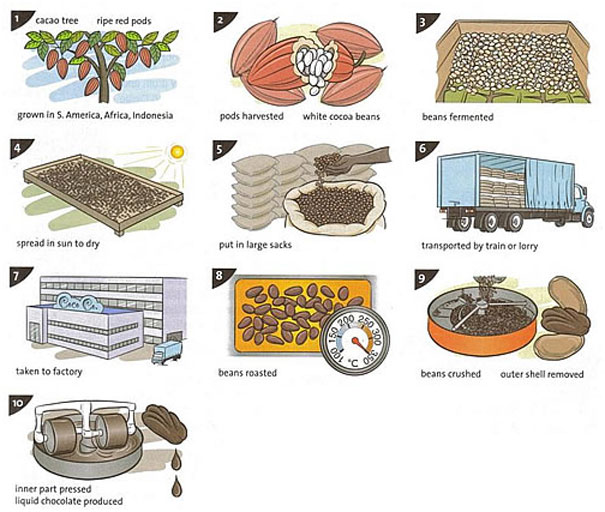
Image source: IELTS buddy
Harvesting and the Yield of a Single Cacao Tree
Unlike many modern agricultural crops, cacao defies mechanization. The harvesting process remains intensely manual. Cacao pods grow directly on the trunk and thick branches of the tree—a botanical phenomenon known as cauliflory. Because the trees flower and fruit continuously throughout the year, ripe pods must be identified visually by their color change (typically turning from green to yellow, orange, or red) and removed carefully by hand using machetes or specialized pruning hooks.
If a harvester damages the "flower cushion" on the trunk where the pod is attached, that specific spot will never produce another pod, permanently reducing the tree's yield. A healthy cacao tree can live for decades, remaining highly productive for about 25 to 30 years.
The yield of a single tree puts the scale of chocolate production into perspective. According to Whitakers Chocolates, a mature tree produces roughly 30 to 40 viable pods annually. Each pod contains between 30 and 50 almond-sized seeds embedded in a sweet, mucilaginous pulp. It takes approximately 80 individual beans—the equivalent of two entire pods—to produce just one standard-sized chocolate bar. This low yield-to-product ratio highlights the immense agricultural footprint required to sustain global chocolate consumption.
The Three Phases of Cocoa Fermentation Chemistry
If raw cacao beans were simply dried and roasted immediately after harvest, the resulting product would be overwhelmingly bitter, astringent, and entirely lacking the characteristic flavor of chocolate. The "birth" of chocolate flavor occurs during fermentation, a complex microbiological process that takes place at the farm level.
When the pods are cracked open, the wet beans and their surrounding sugary pulp are exposed to naturally occurring microbes in the environment. The fermentation process, which typically lasts between 2 and 9 days depending on the method and bean variety, unfolds in three distinct chemical phases, as detailed by research published in the National Institutes of Health (NIH):
(24–36 hours): The dense pulp creates a low-oxygen, highly acidic environment. Yeasts dominate this phase, converting the sugars in the pulp into ethanol (alcohol) and carbon dioxide. The breakdown of the pulp allows liquid to drain away, slowly introducing oxygen into the pile.
(48–96 hours): As oxygen levels slightly increase and the pH shifts, lactic acid bacteria take over. They convert the remaining sugars and some of the newly formed ethanol into lactic acid. This phase begins to alter the internal cellular structure of the bean.
(Final Days): Farmers actively turn and aerate the beans. The influx of oxygen triggers acetic acid bacteria, which oxidize the ethanol into acetic acid. This is a highly exothermic reaction, driving the temperature of the fermentation mass up to 50°C (122°F) or higher. This heat and acid penetrate the bean, killing the germ (preventing germination) and breaking down proteins into the amino acids that serve as crucial flavor precursors.
The physical methodology of fermentation varies by region. In West Africa, the "Heap Method" is common, where beans are piled on banana leaves on the forest floor and covered. In Latin America, the "Box Method" is preferred, utilizing tiered wooden boxes that allow for more controlled aeration and drainage. Both methods aim to facilitate this exact three-phase chemical transition.
Drying and Preparing Beans for Global Shipping
Following fermentation, the beans contain roughly 60% moisture. If shipped in this state, they would rapidly mold and rot. The drying phase is required to reduce the moisture content to a stable 6% to 8%, ensuring the beans can survive long-distance ocean freight to manufacturing facilities in Europe, North America, and Asia.
Drying must be executed carefully. If dried too quickly, the beans trap excessive acetic acid inside, resulting in a harsh, overly acidic final chocolate. If dried too slowly, mold develops, introducing severe off-flavors. The most traditional method is sun drying, where beans are spread across large wooden patios or raised bamboo mats and raked continuously for 5 to 7 days. In regions with frequent rainfall during the harvest season, mechanical dryers using forced hot air are employed, though care must be taken to avoid exposing the beans to wood smoke, which can taint the flavor profile.
Roasting as the Critical Microbiological Kill Step
Once the dried beans arrive at a manufacturing facility, the industrial production of chocolate begins with roasting. While consumers often associate roasting primarily with flavor development, in the context of food manufacturing, it serves a much more critical function: safety.
Raw cacao beans are an agricultural product harvested in open tropical environments. They are fermented on the ground or in wooden boxes, dried in the open air, and shipped in burlap sacks. Consequently, professional chocolate makers treat raw beans with the same microbiological caution as raw meat. According to the Institute of Culinary Education (ICE), raw beans carry significant risks of contamination from pathogens such as Salmonella and E. coli, as well as hitchhiking tropical insects. Roasting serves as the primary "kill step," applying sufficient heat for a sustained duration to eliminate these biological hazards.
Simultaneously, roasting triggers the Maillard reaction. This complex chemical reaction between amino acids and reducing sugars (which were developed during fermentation) occurs at elevated temperatures, transforming the flavor precursors into the rich, complex aromatic compounds we recognize as chocolate.
Roasting profiles vary significantly depending on the manufacturer's goals and the bean variety. Estimates for ideal roasting temperatures range widely depending on the source and application. The ICE suggests a robust range of 148°C to 176°C (300°F to 350°F) for 30 to 60 minutes, which is typical for bulk Forastero beans. However, scientific literature from the NIH indicates that delicate "fine flavor" varieties like Criollo are often roasted at much lower temperatures, between 120°C and 140°C (248°F to 284°F), to preserve their nuanced floral and fruity notes without burning the bean.
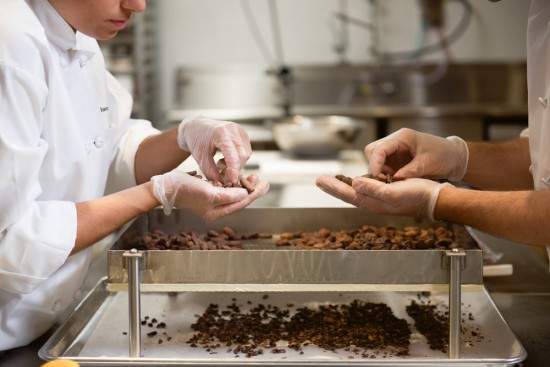
Image source: Institute of Culinary Education
Winnowing and the Strict Standards for Shell Content
After roasting, the beans are cooled and passed through a machine called a cracker, which breaks the whole beans into smaller pieces. The goal of the next step, winnowing, is to separate the edible "meat" of the bean—known as the nib—from the papery, fibrous outer shell (the husk).
Winnowing relies on the principle of specific gravity. The cracked beans are dropped through a series of vibrating screens while a powerful vacuum or blower applies a cross-breeze. Because the shell is significantly lighter than the dense nib, the air current blows the shell away into a collection chute, allowing the heavier nibs to fall straight down into a hopper.
Achieving a clean separation is a strict regulatory and quality control standard. The industry standard dictates that the shell content in the final processed nibs must remain below 1%. Shells are highly fibrous, taste bitter, and can introduce a gritty texture to the final chocolate. More importantly, the outer shell of the cacao bean is where environmental contaminants, including heavy metals like cadmium and lead, tend to accumulate. Minimizing shell content is a crucial step in maintaining food safety standards.
Industrial winnowers are massive, expensive machines. For small-scale and home chocolate makers, the community at TheChocolateLife has developed a popular workaround: constructing a custom winnower using standard PVC pipes and attaching a vortex dust collector (commonly used in woodworking) to a 5-gallon bucket. This setup mimics the airflow dynamics of commercial machines at a fraction of the cost, allowing small batches to achieve the required <1% shell standard.
Grinding and Refining to the 20-Micron Threshold
The pure cocoa nibs are then subjected to intense mechanical grinding. Nibs are composed of roughly 50% cocoa butter (fat) and 50% cocoa solids. As heavy stone or steel rollers crush the nibs, the friction generates heat, which melts the cocoa butter. The solid nibs rapidly transform into a thick, dark, flowing paste known as cocoa liquor or cocoa mass. (Note: Despite the name, cocoa liquor contains no alcohol).
At this stage, sugar, milk powder (for milk chocolate), and additional cocoa butter are added to the liquor. The mixture is then refined to reduce the particle size of the sugar and cocoa solids. This is a critical juncture in the production of chocolate, governed by particle science.
The human tongue is highly sensitive to texture. It can generally detect individual particles that are larger than 35 microns (a micron is one-millionth of a meter). If chocolate is only refined to 40 or 50 microns, it will feel distinctly gritty and sandy in the mouth. To achieve a smooth, luxurious mouthfeel, manufacturers aim to refine the particles down to approximately 20 microns.
| Particle Size Microns | Sensory Mouthfeel | Typical Application |
|---|---|---|
| > 35 Microns | Gritty, sandy, coarse | Traditional rustic styles (e.g., Mexican drinking chocolate, Modica chocolate) |
| 20 - 25 Microns | Smooth, creamy, melts evenly | Premium commercial and craft chocolate bars |
| < 15 Microns | Slimy, sticky, overly thick | Generally avoided; excessive surface area absorbs too much fat, ruining viscosity |
Refining below 15 microns is counterproductive. As particles become smaller, their total surface area increases exponentially. This increased surface area requires more cocoa butter to coat it, meaning ultra-fine chocolate becomes excessively thick and sticky, creating a "slimy" mouthfeel rather than a pleasant melt.
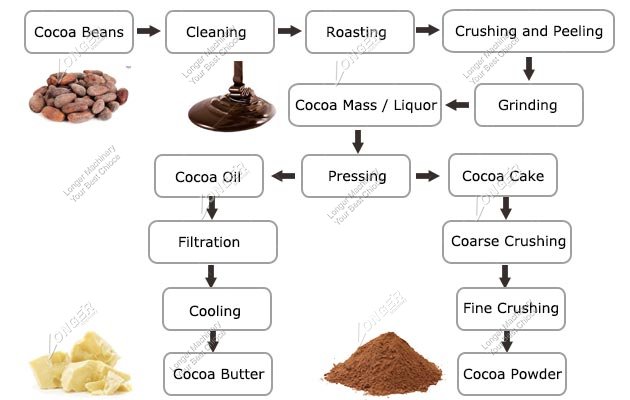
Image source: Manufacturer for Peanut Butter Production Line
Conching and the Removal of Volatile Acids
Following refining, the chocolate undergoes conching, a process invented by Rodolphe Lindt in 1879. Conching involves continuously kneading, agitating, and aerating the liquid chocolate at elevated temperatures (typically between 55°C and 85°C) for anywhere from a few hours to several days.
Conching serves two primary purposes. First, it rounds out the physical texture, ensuring every solid particle is perfectly coated in cocoa butter, which optimizes the rheology (flow properties) of the liquid mass. Second, and more importantly for flavor, the sustained heat and aeration drive off volatile, undesirable compounds—most notably the residual acetic acid left over from the fermentation phase. According to the Culinary Arts Academy Switzerland, conching is the step that transforms the sharp, acidic bite of raw cocoa liquor into the mellow, harmonious flavor profile associated with finished chocolate.
The Science of Tempering for Snap and Shine
Liquid chocolate cannot simply be poured into a mold and placed in a refrigerator. If cooled uncontrolled, the cocoa butter will crystallize randomly, resulting in a dull, crumbly bar that melts instantly on the fingers and develops unappetizing white streaks. To create a commercially viable product, the chocolate must be tempered.
Cocoa butter is polymorphic, meaning it can crystallize into several different structural forms (typically categorized as Forms I through VI). Form V (Beta crystals) is the highly desirable structure. Form V crystals give chocolate its glossy shine, its satisfying audible "snap" when broken, and a melting point that sits just below human body temperature (around 34°C/93°F), allowing it to melt smoothly on the palate.
Tempering is a precise thermal manipulation process. The chocolate is first heated to completely melt all existing crystals. It is then rapidly cooled while being agitated to encourage the formation of both Form IV and Form V crystals. Finally, it is slightly reheated to a highly specific working temperature (around 31°C to 32°C for dark chocolate) to melt away the unstable Form IV crystals, leaving only the stable Form V crystals to seed the rest of the mass as it sets in the mold.
Temperature control is paramount. According to Luker Chocolate, exposing finished chocolate to temperatures above 55°C (131°F) during melting or holding phases can permanently alter its viscosity. Overheating causes the sugar particles to agglomerate (clump together), turning the smooth liquid into a thick, sludgy paste that cannot be pumped through industrial pipes or used for enrobing. This is especially critical for milk and white chocolates, which contain heat-sensitive milk proteins.
Common Production Challenges and Professional Fixes
The production of chocolate is notoriously temperamental, and manufacturers frequently encounter issues that require immediate, scientifically sound interventions.
- Issue: Viscosity is too high (chocolate is too thick to flow).
The Fix: Amateurs often make the fatal mistake of adding water or milk, which instantly seizes the chocolate into a solid block. The only professional correction for overly thick chocolate is the addition of pure, melted cocoa butter (or a commercial emulsifier like soy lecithin) to increase the fat content and restore fluidity. - Issue: Fat Bloom (white, dusty streaks on the surface).
The Fix: Fat bloom occurs when unstable cocoa butter crystals melt and migrate to the surface, recrystallizing as visible white streaks. This is caused by improper tempering or poor storage conditions (fluctuating temperatures). The chocolate is perfectly safe to eat, but visually compromised. The fix is to completely remelt the batch and execute the tempering curve from scratch. - Issue: Equipment failure in small-batch melangers.
The Fix: Small-scale makers using tabletop stone grinders often experience drive belt stretching and snapping due to the immense torque required to crush nibs. A widely adopted industry hack is replacing standard rubber belts with "PowerTwist" fiberglass link belts, which resist stretching and allow for custom tensioning without dismantling the machine.
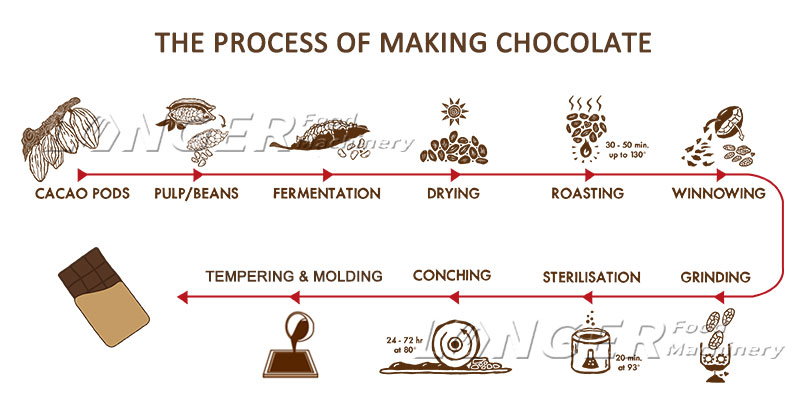
Image source: Chocolate Making Machine
How to Start Small-Scale Production at Home
Historically, chocolate making was restricted to massive industrial conglomerates due to the prohibitive cost of refining equipment. However, the rise of the "craft" or "micro-batch" movement has democratized the process. Today, aspiring makers can produce high-quality chocolate at home or in small commercial kitchens.
The barrier to entry was lowered significantly by the adaptation of the Indian wet grinder (traditionally used for making dosa batter) into the modern tabletop chocolate melanger. Brands like Premier and Butterfly offer small stone grinders capable of refining cocoa nibs and sugar down to the requisite 20-micron threshold over a 24-to-48-hour period. Home makers typically roast raw beans in a standard convection oven, crack them using a modified grain mill, and winnow using the DIY PVC methods mentioned earlier. Sourcing ethical, transparently traded raw beans has also become highly accessible through specialized brokers who cater to the micro-batch community.
The Economics and Ethics of the Global Supply Chain
While the technical production of chocolate is a marvel of food science, the economic realities of the supply chain remain a significant challenge. The industry is characterized by a stark imbalance of value distribution.
Despite being the foundational element of a multi-billion-dollar global industry, the farmers who cultivate, harvest, and ferment the cacao beans capture a disproportionately small share of the profits. Data from the World Cocoa Foundation and various economic analyses reveal the "6% Reality"—on average, cocoa farmers receive only about 6% of the final retail price of a standard chocolate bar. The vast majority of the value is captured downstream by manufacturers, marketers, and retailers. This economic disparity drives ongoing initiatives within the craft chocolate sector to promote direct-trade models, ensuring higher farm-gate prices and more sustainable livelihoods for growers in the Cocoa Belt.
Frequently Asked Questions
- How long does it take to produce a single chocolate bar?
- From the moment a pod is harvested to the final molding of a bar, the process spans several weeks. Fermentation and drying take roughly 10 to 14 days at the farm level. Once the dried beans reach a manufacturer, the roasting, refining, conching, and tempering processes typically take an additional 3 to 5 days, depending on the conching duration.
- Can you make chocolate at home from raw cocoa beans?
- Yes, small-scale production is entirely feasible. You can roast raw beans in a standard home oven, crack them, and winnow away the shells using a hair dryer or custom vacuum setup. The critical piece of equipment required is a tabletop stone melanger, which is necessary to grind the nibs and sugar down to a smooth, palatable texture over 24 to 48 hours.
- What is the "kill step" in chocolate production?
- Roasting serves as the primary microbiological kill step. Because raw cacao beans are fermented and dried in open tropical environments, they carry risks of pathogens like Salmonella. Applying sustained heat during roasting (typically between 120°C and 176°C, depending on the bean and desired flavor) ensures the beans are safe for human consumption.
- Why is my homemade chocolate gritty?
- Grittiness occurs when the chocolate has not been refined sufficiently. The human tongue detects particles larger than 35 microns. Standard food processors and blenders cannot grind sugar and cocoa solids fine enough. To eliminate grit, the chocolate must be processed in a stone melanger until the particle size drops to approximately 20 microns.
- Is white chocolate actually chocolate?
- This is a subject of industry debate. White chocolate contains cocoa butter (the natural fat extracted from the cacao bean), sugar, and milk powder, but it contains zero cocoa solids or cocoa liquor. While purists argue it lacks the defining characteristics of chocolate, regulatory bodies generally classify it as a chocolate derivative because its primary ingredient is derived directly from the cacao bean.
The Bottom Line on Chocolate Production
The journey from a tropical pod to a finished bar is a rigorous process that demands precision at every stage. Skipping or rushing any step fundamentally compromises the safety, texture, and flavor of the final product.
- Fermentation is Mandatory: Chocolate is a fermented food. Without the 3-phase bacterial breakdown of the pulp, the beans will never develop the chemical precursors required for chocolate flavor.
- Roasting is for Safety and Flavor: Beyond triggering the Maillard reaction for aroma, roasting is the non-negotiable kill step that eliminates agricultural pathogens.
- Texture is a Science: Achieving a luxurious mouthfeel requires mechanical refining to hit the specific 20-micron threshold—any larger is gritty, any smaller becomes unpleasantly sticky.
- Tempering Controls the Fat: The snap and shine of a professional bar rely entirely on thermal manipulation to isolate and stabilize Form V cocoa butter crystals.