How Much Do Underwater Welders Actually Make in 2026?
As of mid-2026, the average underwater welder earns between $68,000 and $100,000 per year. However, the range is exceptionally broad: entry-level "tenders" may start near $40,000, while elite saturation divers working offshore can exceed $300,000 annually. Your final paycheck depends heavily on depth bonuses, union status, and whether you work inland or offshore.
The allure of underwater welding often stems from viral stories of divers making thousands of dollars a day. While these figures are grounded in reality, they represent a specific tier of the industry that requires years of grueling experience and significant physical risk. To understand how much you will actually take home, you must look past the headlines and into the specific mechanics of commercial diving contracts.
In 2026, the industry remains a high-demand trade, but it is not a "get rich quick" scheme. According to data from the American Welding Society (AWS), while "go-getters" can certainly reach the six-figure mark, the national median reflects a more grounded reality for those working on inland infrastructure like bridges and dams.
Why the $300,000 Salary Is Both Real and Extremely Rare
The $300,000 figure frequently cited in career brochures refers almost exclusively to Saturation Diving. This is the pinnacle of the profession, where divers live in a pressurized habitat for up to 28 days at a time to avoid the need for daily decompression. Because the body remains "saturated" with inert gas at the working depth, these divers can work for hours at hundreds of feet below the surface.
What Is Saturation Diving and Why Does It Pay So Much?
Saturation diving pay is high because of the extreme physiological toll and the specialized nature of the work. Companies pay a massive "hazard premium" because the divers are essentially living in a pressurized tank for a month. If an emergency occurs on the surface, the divers cannot simply swim up; they are committed to a decompression schedule that can last several days. According to industry reports from Tallo, this sector is where the top 1% of earners reside, often working in the oil and gas fields of the Gulf of Mexico or the North Sea.
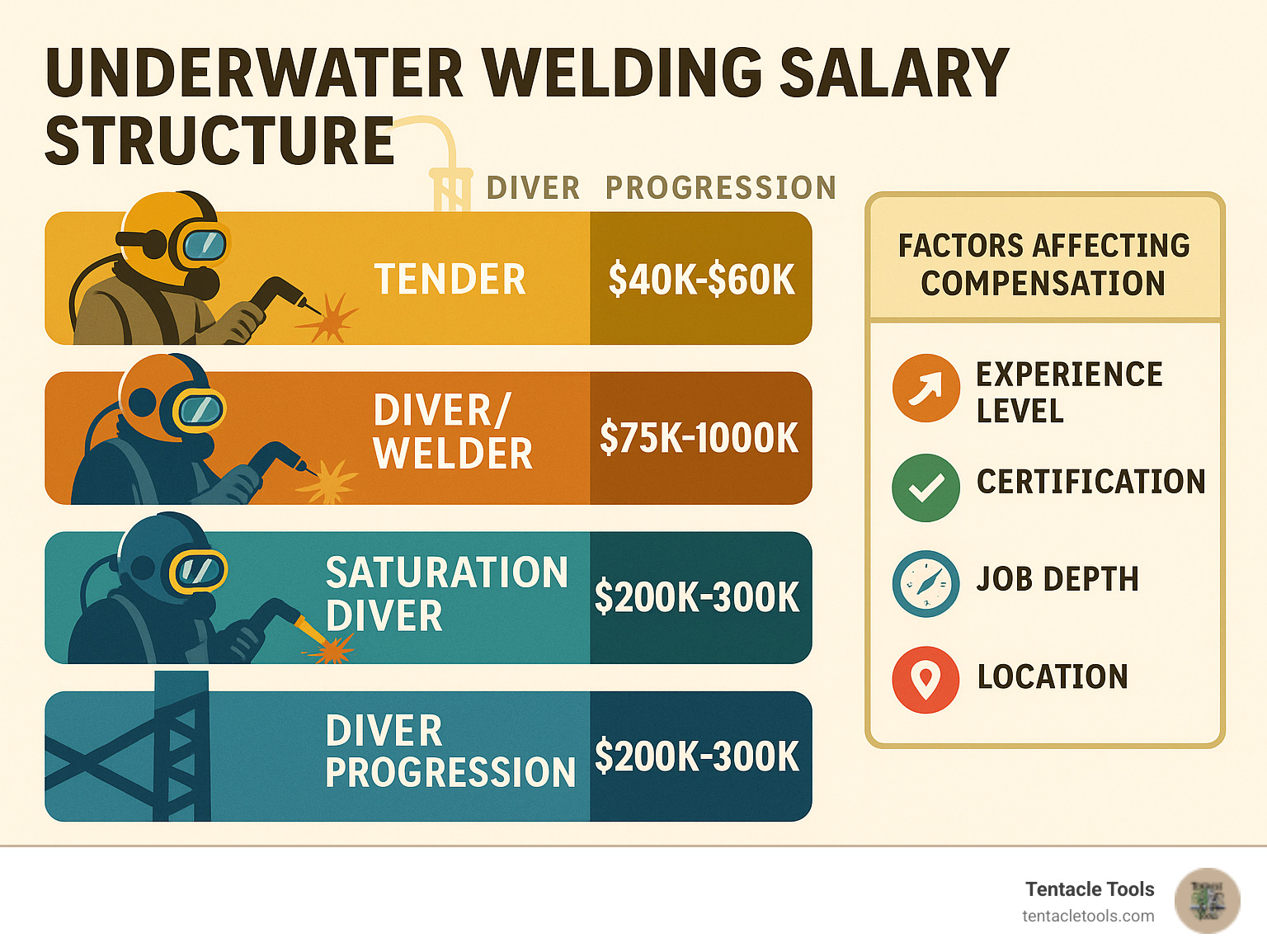
Image source: Tentacle Tools
The Difference Between Wet Welding and Hyperbaric Dry Welding
Not all underwater welding is done "in the wet." Hyperbaric dry welding involves building a pressurized enclosure (a habitat) around the weld site and pumping out the water. This allows for high-quality welds that meet strict structural codes. Because dry welding requires more complex logistics and higher precision, it typically commands a higher hourly rate than "wet" welding, which is often used for temporary repairs or non-critical structures.
How Your Pay Changes from Your First Day to Your Last Dive
One of the most common misconceptions is that you will be welding on your first day out of school. In reality, the commercial diving industry follows a strict apprenticeship model. You don't start as a diver; you start as a Tender.
The Tender Phase
Years: 0–2
Pay: $40k – $55k
New grads work as surface support, hauling hoses and maintaining gear. You "earn your fins" here before being allowed to dive regularly.
Inland Diver
Years: 2–5
Pay: $60k – $90k
Working on bridges, dams, and water towers. This is stable work, often allowing you to be home every night.
Offshore Specialist
Years: 5–10
Pay: $100k – $180k
Working on oil rigs and pipelines. High intensity, seasonal work with significant overtime and depth bonuses.
The Reality of Starting as a Diver Tender
As a tender, your primary job is to ensure the safety of the diver in the water. You are the lifeline, literally. Hourly rates for tenders typically range from $15 to $25 per hour. While this may seem low compared to the "dream salary," it is a mandatory phase of the career. Industry veterans on platforms like Reddit emphasize that your performance as a tender determines how quickly you get promoted to "break out" as a full diver.
Moving from Inland Projects to Offshore Rigs
The jump from inland to offshore is where the salary truly scales. Inland work is often based on standard 40-hour weeks with occasional overtime. Offshore work, however, is usually "hit based." You might work 12 hours a day for 30 days straight, followed by two weeks off. The combination of high hourly rates, guaranteed overtime, and "offshore bonuses" is what pushes these salaries into the six-figure range.
Understanding the Math Behind Your Paycheck
Unlike a standard office job, an underwater welder's pay is modular. Your base rate is just the starting point. The real money is made through Depth Pay and Hazard Pay.
How Depth Pay Bonuses Increase Your Hourly Rate
Depth pay is a per-foot bonus paid for every foot you descend past a certain threshold (usually 50 feet). This is designed to compensate for the increased physical risk and decompression time required for deeper dives. In 2026, a typical depth pay schedule might look like this:
| Depth Range | Additional Pay (Per Foot) | Example 150ft Dive Bonus |
|---|---|---|
| 0 – 50 Feet | Included in Base | $0 |
| 50 – 100 Feet | $1.50 / foot | $75.00 |
| 100 – 150 Feet | $3.00 / foot | $150.00 |
| Total Bonus | -- | $225.00 per dive |
The Massive Difference Between Union and Non-Union Pay
Geography and union affiliation are perhaps the biggest variables in your earnings. In the Gulf of Mexico, which is largely non-union, starting rates can be as low as $20–$30 per hour. Conversely, a Union Piledriver/Diver in a high-cost area like New Jersey or California might have a total package (including benefits) exceeding $100 per hour. Union jobs also offer superior pension plans and health insurance, which are critical in a career that is physically taxing.
Is the High Salary Worth the Physical Risk?
Before jumping into this career, you must perform a cold, hard ROI (Return on Investment) analysis. Commercial diving school is not cheap, and the gear requirements are substantial.
The "Break-Even" Calculator
To reach a "net positive" financial state, most divers need approximately 2.5 years of consistent work. Here is the breakdown:
- Investment: $25,000 (Tuition) + $5,000 (Gear/Certs) = $30,000
- Year 1 (Tender): $45,000 Gross - $35,000 Living Expenses = $10,000 Profit
- Year 2 (Tender/Junior Diver): $55,000 Gross - $35,000 Living Expenses = $20,000 Profit
By the end of Year 2, you have technically "paid off" your education. From Year 3 onward, your earning potential scales rapidly as you move into specialized diving roles.
However, the financial ROI doesn't account for the physical toll. Long-term exposure to high pressure can lead to bone necrosis, hearing loss, and chronic joint pain. According to Ocean Corp, the average career span for a diver in the water is often less than 15 years. You are essentially trading your physical "prime" for a higher-than-average salary.
How to Transition Out of the Water After Age 40
Smart divers begin planning their "exit strategy" the day they graduate. Because the body can only handle so many pressure cycles, most divers transition to surface roles by their early 40s. These roles often pay as much as, or more than, active diving roles because they require the wisdom of a veteran.
- Certified Welding Inspector (CWI)
- Using your knowledge of underwater weld defects to inspect others' work from the surface. This is a high-paying, low-impact role.
- Dive Supervisor
- Managing the dive team, gas mixtures, and safety protocols from the dive shack. You are the "brain" of the operation.
- Project Management
- Moving into the corporate side of marine construction, bidding on contracts and managing logistics for multi-million dollar projects.
Frequently Asked Questions
Do underwater welders really make $300,000 a year?
Yes, but this figure is reserved for the top 1% of the industry—specifically saturation divers with over a decade of experience working in hazardous offshore environments. For the average diver, a salary between $70,000 and $100,000 is a much more realistic expectation in 2026.
What is the highest-paying state for underwater welders?
Louisiana and Texas offer the highest volume of work due to the Gulf oil industry. However, states like California, New Jersey, and Washington often have the highest hourly rates due to strong union presence and higher costs of living. Estimates from ZipRecruiter suggest that coastal hubs consistently outperform inland states.
How long does it take to become an underwater welder?
Most commercial diving programs last between 6 and 12 months. After graduation, you must spend 1 to 2 years as a "tender" before you are typically allowed to perform significant underwater welding tasks on major projects. Total time to reach "full" diver status is usually 2–3 years.
Is the job as dangerous as people say?
Statistically, commercial diving is one of the most dangerous professions in the United States. Risks include decompression sickness, drowning, and differential pressure (Delta-P) hazards. This high risk is exactly why the pay scales are significantly higher than standard topside welding roles.
Why is there such a big difference in salary reports?
Salary reports vary because some sources, like Payscale, may rely on a small sample of highly experienced offshore divers, while others include entry-level tenders and inland workers. When researching, always distinguish between "base pay" and "total compensation" including bonuses.
The Bottom Line on Underwater Welding Earnings
Underwater welding is a challenging but financially rewarding trade for those willing to put in the time and manage the risks. Here are the key takeaways for 2026:
- Expect a modest start: Most newcomers earn $40k–$50k as tenders while learning the ropes.
- Specialization is key: Saturation diving and hyperbaric dry welding are the primary paths to a $200k+ salary.
- Union status matters: Joining a union can nearly double your hourly rate and provide a vital safety net.
- Location dictates volume: The Gulf Coast remains the hub for offshore work, while major coastal cities offer high-paying union infrastructure jobs.
- Plan for the future: The physical toll means you should have a transition plan into inspection or management by age 40.
- ROI takes time: It typically takes 2 to 3 years to fully recoup the costs of dive school and equipment.
If you are entering the field, focus on mastering your topside welding skills first, as a diver who cannot weld is of little value to a commercial firm.