How Natural Rubber Is Produced From Tree To Industrial Raw Material
The Biological Engine of the Rubber Industry
Before it becomes a tire on a commercial airliner or a seal in an industrial pipeline, natural rubber begins as a biological defense mechanism. Chemically known as polyisoprene, natural rubber is harvested as a milky white sap called latex. When a rubber tree is wounded by insects or environmental damage, it secretes this sticky substance to seal the breach and trap potential pathogens.
While over 2,500 plant species produce some form of latex, the global commercial industry relies almost entirely on a single species: Hevea brasiliensis. Native to the Amazon basin, this remarkable tree serves as the biological engine for a massive global supply chain. As of recent data spanning 2024 to 2026, the world consumes approximately 14.5 million metric tons of natural rubber annually. Despite advances in synthetic alternatives, the unique molecular structure of natural polyisoprene remains highly sought after for applications requiring exceptional tensile strength and heat dispersion.
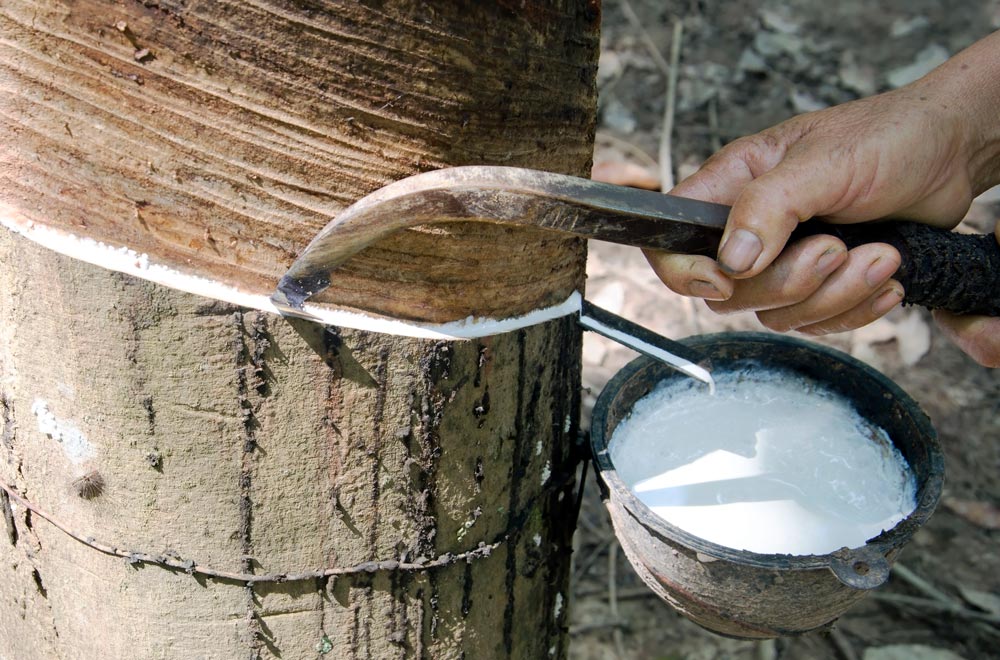
Image source: Rubber Chemicals
Why Only One Tree Species Rules the Global Market
During the late 19th century, a botanical "Rubber Race" occurred as industrialists sought the most efficient source of natural latex. Two primary contenders emerged from South America: Hevea brasiliensis and Castilla elastica.
Hevea ultimately dominated the market due to a critical anatomical advantage: its latex vessels (laticifers) are interconnected. When a tapper makes a single cut in the bark of a Hevea tree, the interconnected network allows latex to flow continuously from a wide area of the trunk. In contrast, the latex vessels in Castilla trees are isolated; cutting the bark only drains the immediate area, requiring the tree to be felled or extensively damaged to harvest a meaningful yield. According to historical and botanical analyses, this interconnected vessel system is why Hevea can be harvested sustainably for decades.
The geographic center of production also shifted dramatically due to a single historical event. In 1876, British explorer Henry Wickham smuggled approximately 70,000 Hevea seeds out of Brazil. These seeds were germinated at Kew Gardens in London and subsequently dispatched to British colonies in Ceylon (Sri Lanka), Singapore, and Malaya. This botanical transfer established the modern Southeast Asian rubber industry. South America later lost its dominance entirely due to the devastating spread of South American Leaf Blight (Microcyclus ulei), a fungal disease that prevents high-density plantation farming in the Amazon to this day.
How to Grow a Productive Rubber Plantation
Establishing a rubber plantation requires significant patience and precise agricultural management. Rubber trees are not planted and harvested in a single season; they represent a long-term agricultural investment.
The cultivation process follows strict geographical and biological parameters:
- The Rubber Belt: Hevea brasiliensis requires a specific tropical climate found roughly 15 degrees north and south of the equator. The trees demand high annual rainfall (typically over 2,000 mm), high humidity, and an environment completely free of frost.
- Planting Density: Modern plantations maintain a strict density of approximately 550 trees per hectare. This spacing ensures adequate sunlight penetration for canopy development while allowing sufficient airflow to mitigate fungal diseases.
- The Maturation Period: From the time a seedling is planted, farmers must wait six to seven years before the tree reaches a sufficient girth (usually 50 cm in circumference at a height of 1 meter) to survive the tapping process.
During this seven-year waiting period, the trees generate no income, requiring farmers to often intercrop with bananas, cacao, or cover crops to maintain soil health and generate interim revenue.
The Physics of Tapping and Why Timing Matters
Harvesting latex—a process known as tapping—is a highly skilled task that relies heavily on plant physics. The goal is to sever the latex vessels located in the inner bark without damaging the cambium, the vital growth layer of the tree. If the tapper cuts too deeply and strikes the cambium, the tree will form woody scars that ruin the panel for future tapping. If the cut is too shallow, the yield drops significantly.
The timing of the tap is dictated by turgor pressure. Industrial rubber experts note that tapping must occur between sunrise and roughly 10:00 a.m. During the cool, early morning hours, the tree's transpiration rate (water loss through leaves) is at its lowest, meaning the internal water pressure within the plant cells is at its peak. This high turgor pressure actively forces the latex out of the severed vessels. As the day warms up and the tree begins to transpire, the internal pressure drops, and the latex naturally thickens and seals the cut.
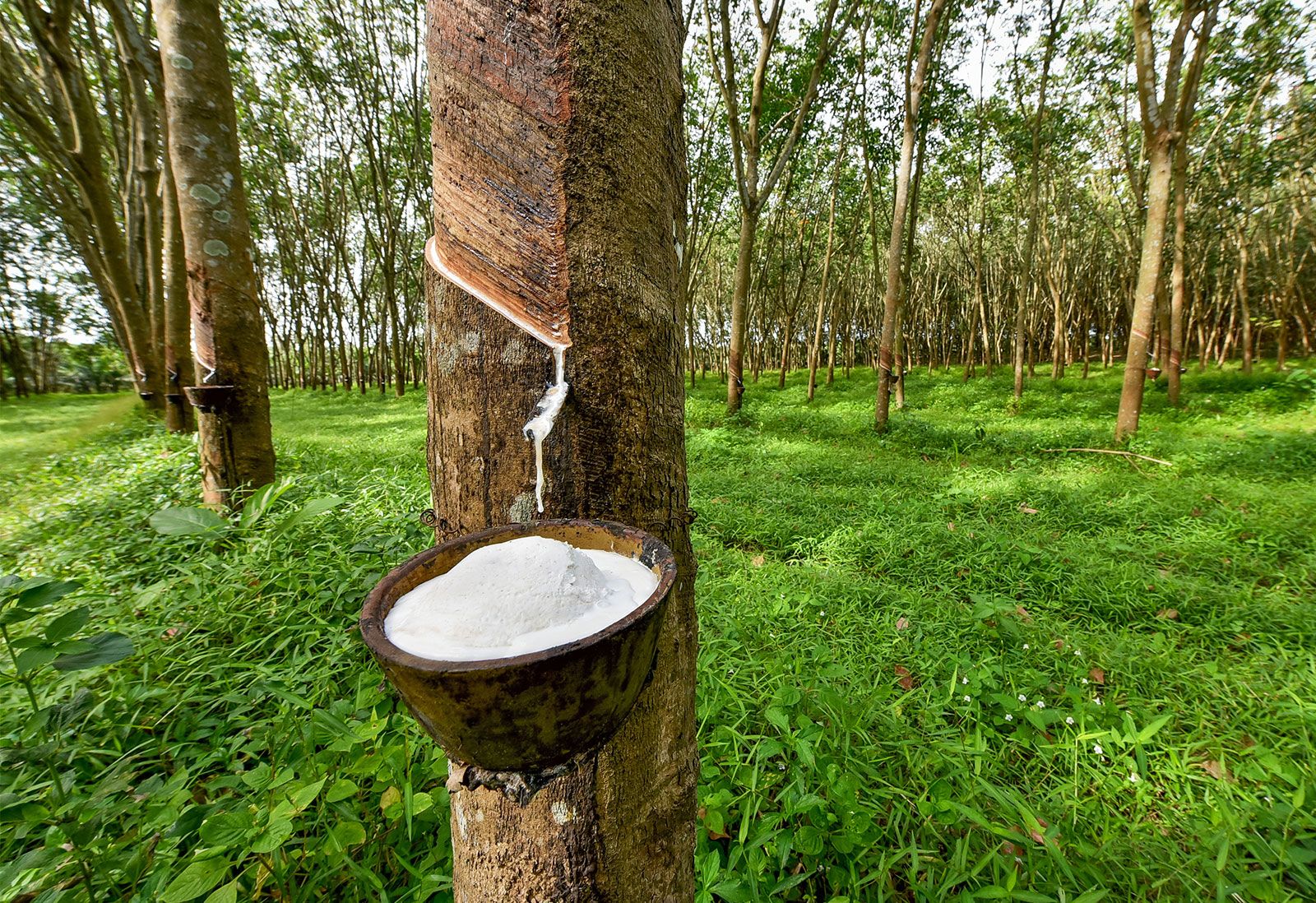
Image source: Britannica
A standard cut is made at a 25 to 30-degree downward angle. This specific geometry ensures the cut intersects the maximum number of latex vessels, which naturally spiral up the trunk from right to left. Over its 25 to 30-year productive lifespan, a single healthy tree will yield between 60 and 150 kilograms of raw rubber.
What Happens to Latex After It Leaves the Tree
When latex drips into the collection cup, it is known as "field latex." In this raw state, it is a colloidal suspension consisting of roughly 30-40% rubber hydrocarbon particles and 60% water, proteins, and resins. Field latex is highly unstable; if left untreated in the tropical heat, naturally occurring bacteria will consume the proteins and cause the liquid to putrefy and solidify prematurely.
To manage this, the production process moves rapidly through two chemical phases:
1. Chemical Stabilization
Immediately upon collection, ammonia is added to the liquid latex. Ammonia serves a dual purpose: it acts as a powerful biocide to kill bacteria, and it raises the pH of the solution. The rubber particles in latex carry a negative electrical charge, which causes them to repel each other and stay suspended in the water. Ammonia maintains this negative charge, keeping the latex in a stable, liquid state for transport to processing facilities.
2. Controlled Coagulation
Once the liquid reaches a processing center, the goal reverses: the rubber must be separated from the water. Technicians add mild acids, typically formic acid or acetic acid, to the vats. The acid lowers the pH, neutralizing the negative charges on the rubber particles. No longer repelling each other, the polymer chains collide and bind together, forming a spongy, solid mass known as "coagulum."
Transforming Raw Latex into Industrial Sheets and Blocks
The wet coagulum is still far from the material used in manufacturing. It contains trapped water, bark fragments, and dirt that must be removed through intensive milling.
The coagulum is passed through a series of heavy steel rollers. These rollers crush the material, squeezing out the acidic water and flattening the rubber into thin, continuous sheets. Depending on the target market, the rubber is then processed into one of two primary commercial forms:
The milled sheets are hung in large smokehouses and cured over wood fires for several days. The smoke acts as a natural fungicide, preventing mold growth during international shipping. RSS is graded visually (from RSS 1 to RSS 5) based on color, clarity, and the absence of bubbles or bark flaws.
Also known as block or crumb rubber, TSR is created by shredding the coagulum into small crumbs, washing it extensively, and drying it in massive hot-air ovens before pressing it into standardized blocks. Unlike RSS, TSR is graded in a laboratory based on precise chemical properties (dirt content, ash, nitrogen levels).
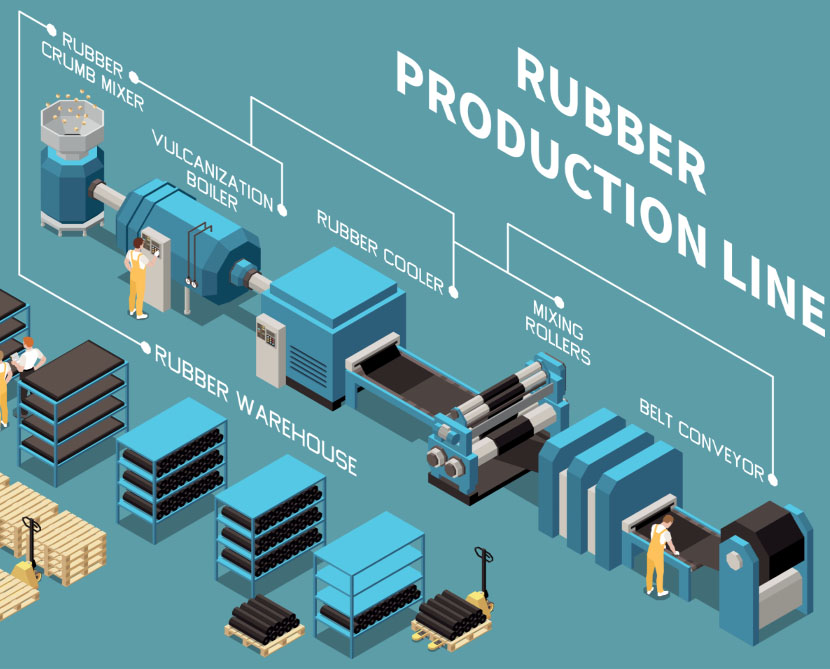
Image source: Samarali
The Vulcanization Process: A Major Industrial Advancement
Even in its processed sheet or block form, raw natural rubber has severe limitations: it becomes sticky and melts in hot weather, and turns brittle and shatters in the cold. The material only becomes industrially viable through vulcanization.
Discovered by Charles Goodyear in 1839, vulcanization involves mixing the raw rubber with sulfur and subjecting it to intense heat and pressure. The sulfur atoms form cross-links between the long polyisoprene chains, locking them into a stable, three-dimensional web. While early vulcanization could take hours, modern industrial facilities utilize chemical accelerators that complete the curing process in just 15 to 20 minutes, resulting in the highly durable, elastic material we rely on today.
Who Are the Real Producers in the Global Supply Chain
When visualizing rubber production, many picture massive corporate plantations. However, the reality of the supply chain is vastly different. According to supply chain analyses, approximately 85% to 90% of all natural rubber is produced by smallholder farmers. These are individual families managing plots of land typically ranging from one to three hectares.
Because the industry relies on millions of independent farmers, it is highly vulnerable to price volatility. When global rubber prices drop, smallholders often cannot cover their living expenses. This leads to "abandoned" plantations where trees are left untapped, or farmers cutting down healthy rubber trees to plant more lucrative crops like oil palm. This dynamic frequently leads to delayed supply shortages in the global market.
As of 2026, the geographic distribution of rubber production is undergoing a significant structural shift. The traditional dominance of Southeast Asia is fracturing due to biological and economic pressures:
Recent market intelligence reports highlight a dramatic 35% contraction in Indonesian rubber production between 2019 and the present. This decline is largely attributed to the spread of Pestalotiopsis (circular leaf fall disease), which strips the trees of their canopy and halts latex production, combined with prolonged periods of low market prices that discouraged replanting. Meanwhile, countries like Vietnam and the Ivory Coast have rapidly expanded their planting acreage, shifting the center of gravity in the global supply chain.
Natural Rubber vs Synthetic Rubber and Which One You Need
Since the mid-20th century, petrochemical-based synthetic rubbers (like Styrene-Butadiene Rubber or SBR) have captured a large share of the market. However, natural rubber remains irreplaceable in specific high-stress applications. Choosing between the two depends entirely on the mechanical and chemical requirements of the end product.
| Property | Natural Rubber (Polyisoprene) | Synthetic Rubber (e.g., SBR, Nitrile) |
|---|---|---|
| Tensile Strength | Exceptionally high; resists tearing under extreme physical stress. | Moderate; often requires reinforcing fillers like carbon black. |
| Heat Build-up (Hysteresis) | Low heat generation during repeated flexing. Crucial for aviation and truck tires. | Higher heat generation; prone to thermal degradation under heavy loads. |
| Oil & Chemical Resistance | Poor. Absorbs petroleum-based oils, causing the rubber to swell and disintegrate. | Highly resistant (specifically Nitrile/NBR). Ideal for engine seals and fuel hoses. |
| Temperature Extremes | Becomes brittle at very low temperatures and degrades under high UV/ozone exposure. | Can be engineered to withstand extreme cold, heat, and prolonged UV exposure (e.g., Silicone, EPDM). |
| Source Material | Renewable agricultural resource (tree sap). | Derived from non-renewable petroleum byproducts. |
To put the industrial demand into perspective, major tire manufacturers note that a single large earthmover tire can require up to one full tonne of natural rubber. The aviation and heavy machinery industries rely on natural rubber because synthetic alternatives generate too much internal heat under the massive load of a landing aircraft or a mining truck, which would cause the tire to blow out.
Is the Future of Rubber Production Sustainable
The environmental footprint of natural rubber is complex. On one hand, it is a renewable resource that sequesters carbon during the tree's 30-year lifespan. On the other hand, the expansion of rubber plantations has historically contributed to tropical deforestation.
Today, the industry is moving toward a more circular economy. When a Hevea tree reaches the end of its latex-producing life (around 25 to 30 years), it is no longer burned as waste. Instead, the timber—known as rubberwood—is harvested and treated for use in high-end furniture manufacturing, flooring, or processed into biomass for renewable energy generation.
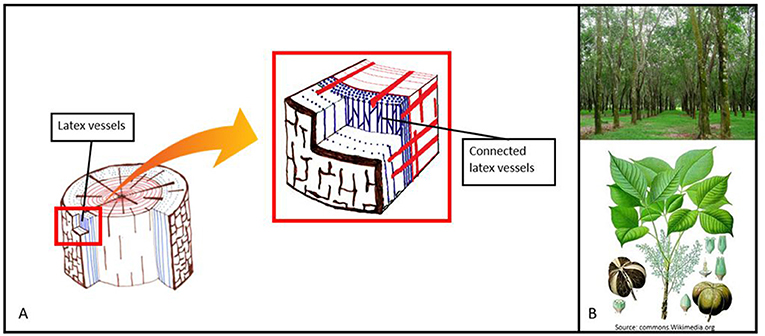
Image source: Frontiers for Young Minds
Furthermore, due to the vulnerability of relying on a single tree species concentrated in Southeast Asia, botanical researchers are actively developing alternative sources. The two most promising candidates are Guayule (a desert shrub native to North America) and Taraxacum kok-saghyz (the Russian dandelion). Both plants produce viable polyisoprene in their roots or bark and can be grown in temperate climates, potentially offering a localized "Plan B" for the global rubber supply.
The most significant sustainability hurdle remains end-of-life recycling. Because vulcanization is a thermoset process—meaning the chemical bonds are permanently locked—old tires cannot simply be melted down and remolded like plastic. While devulcanization technologies are improving, the majority of recycled rubber is currently downcycled into playground surfaces, asphalt additives, or burned as tire-derived fuel.
Frequently Asked Questions
- How long does it take for a rubber tree to start producing latex?
- A newly planted Hevea brasiliensis seedling requires approximately six to seven years of growth before it reaches maturity. The tree must attain a specific trunk girth (usually 50 cm at a height of one meter) before it can safely withstand the physical stress of the tapping process without stunting its future growth.
- Why is rubber production shifting away from Indonesia?
- Recent data indicates a roughly 35% contraction in Indonesian rubber production. This is primarily driven by widespread outbreaks of Pestalotiopsis (a fungal leaf fall disease) that severely reduces latex yields. Combined with prolonged periods of low market prices, many Indonesian smallholders have abandoned rubber tapping in favor of more profitable crops.
- Can you produce rubber without killing the tree?
- Yes. Tapping is a non-lethal harvesting method when performed correctly. A skilled tapper cuts only into the latex vessels located in the inner bark, carefully avoiding the cambium (the tree's growth layer). A single tree can be tapped regularly for 25 to 30 years before its yield naturally declines.
- What is the difference between latex and rubber?
- Latex is the raw, liquid sap extracted directly from the tree; it is a colloidal suspension of rubber particles in water. Rubber is the processed, solid material created after the latex has been chemically coagulated, milled to remove moisture, dried, and eventually vulcanized for industrial use.
- Why is ammonia added to raw latex?
- Ammonia is added to field latex immediately after collection to act as a stabilizer and biocide. It raises the pH of the liquid, which maintains the negative electrical charge of the rubber particles so they repel each other and stay suspended. It also kills naturally occurring bacteria that would otherwise cause the latex to putrefy and clump prematurely.
The Bottom Line
The journey from a tropical tree to an industrial tire is a complex blend of botany, physics, and chemistry. Understanding this supply chain reveals why natural rubber remains a critical, irreplaceable resource in modern manufacturing.
- Biological Monopoly: Hevea brasiliensis dominates the market because its interconnected latex vessels allow for continuous, sustainable harvesting.
- Precision Harvesting: Tapping relies on early-morning turgor pressure to maximize yield, requiring skilled labor to avoid damaging the tree's growth layer.
- Smallholder Foundation: Approximately 85% to 90% of global supply is produced by independent family farms, making the market highly sensitive to price fluctuations.
- Geographic Shifts: Disease pressures and economic factors are causing production to shift away from traditional hubs like Indonesia toward emerging markets in Vietnam and West Africa.
- Irreplaceable Properties: Despite synthetic alternatives, natural rubber's low heat build-up and high tensile strength make it mandatory for high-stress applications like aviation and heavy machinery.