How to Build a New Product Development Checklist That Actually Works
Quick Answer: A highly effective new product development (NPD) checklist bridges the gap between traditional manufacturing rigor and modern Agile speed. By following a structured 7-stage framework—Ideation, Screening, Concept Development, Prototyping, Validation, Commercialization, and Post-Launch Review—teams can systematically reduce technical debt, ensure regulatory compliance, and significantly lower the historical 80% failure rate of new product launches.
Every year, approximately 30,000 new products are launched into the consumer and B2B markets. Yet, despite advanced technology and massive marketing budgets, a staggering percentage of these products fail to gain traction. The problem rarely lies in a lack of creativity; rather, it stems from a lack of structured execution.
Most standard checklists available online are too generic. They operate as simple to-do lists rather than rigorous decision-making frameworks. This leads to "Technical Debt"—where rushed decisions early in the design phase cause massive manufacturing or software bottlenecks later—or missed regulatory requirements that halt a launch entirely.
To mitigate these risks, organizations must adopt a hybrid framework. This approach combines the strict, auditor-ready documentation of the traditional Stage-Gate methodology with the iterative, rapid-feedback loops of Agile development. This guide breaks down the exact 7-stage new product development checklist required to bring a concept from a raw idea to a profitable, market-ready reality.
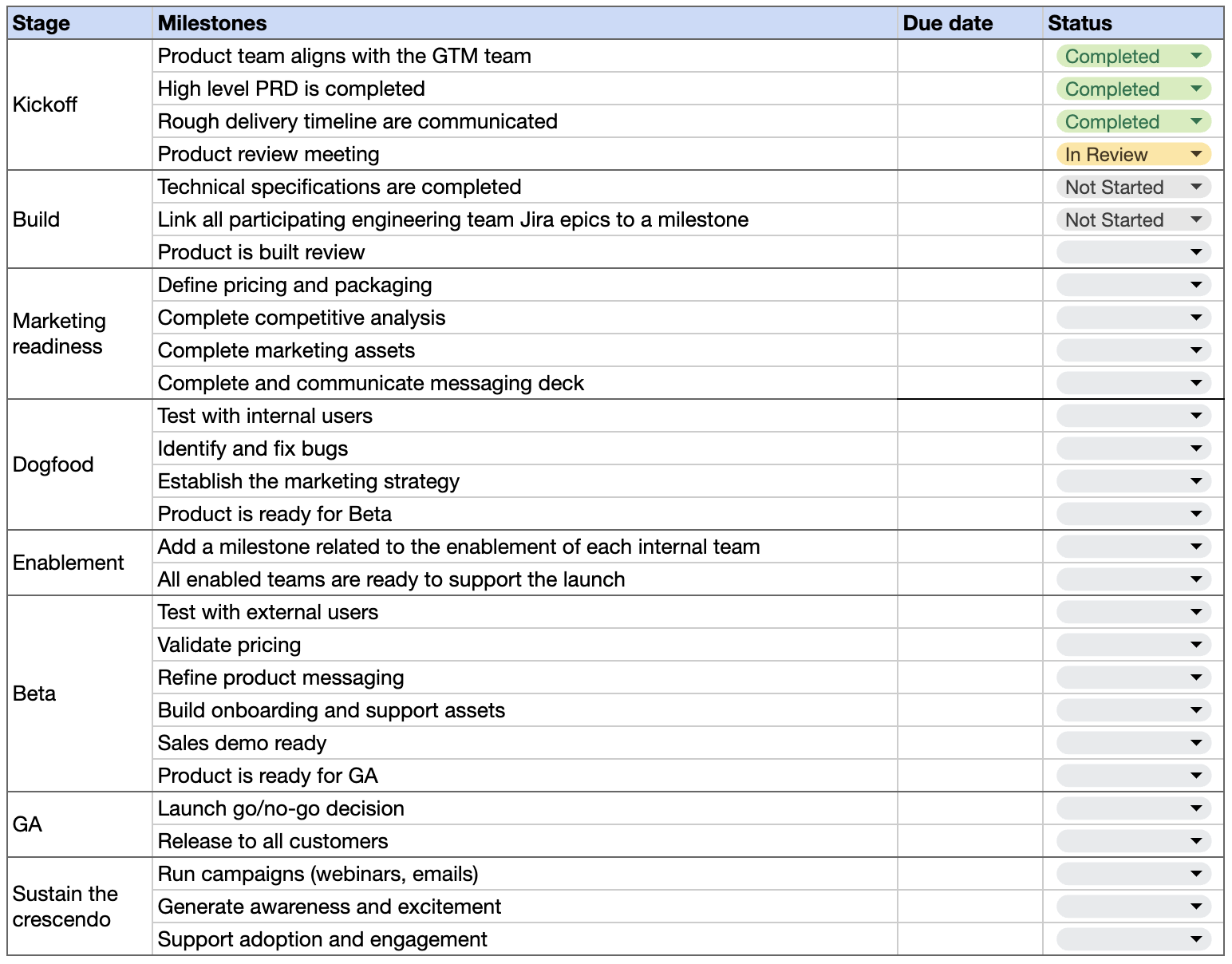
Image source: Luna AI
Why Most New Products Fail Before They Reach the Shelf
Before diving into the checklist itself, it is crucial to understand what goes wrong when a structured process is ignored. The stakes for product development are incredibly high, and the financial penalties for failure can be devastating to an organization's bottom line.
According to data compiled by HubSpot and Hanover Research, the average cost of a failed product launch is roughly $15 million. Furthermore, the failure rate for new products is notoriously high. While estimates range from 70% (according to the late Harvard Business School professor Clayton Christensen) to as high as 80% depending on the industry, the consensus is clear: the vast majority of new ideas do not survive contact with the market.
Why does this happen? Research indicates that 60% of project failures stem from poor planning and miscommunication rather than poor product quality. Teams often rush through the feasibility and screening stages because they are eager to start building prototypes.
Additionally, the modern market moves faster than ever. Approximately 33% of products now have a lifecycle of less than one year. This lifecycle crunch means that speed-to-market is critical, but speed without a structured checklist results in missed compliance steps, supply chain breakdowns, and ultimately, product failure. Companies that utilize a robust, stage-gated process average 130% more revenue from new products than those that rely on ad-hoc development methods.
Stage 1 — Generate and Refine High-Value Ideas
The first stage of the new product development checklist is ideation. However, this should not be an unstructured brainstorming session. Ideas must be generated with specific market pain points in mind, utilizing structured frameworks to ensure viability from day one.
Using the SCAMPER Method
Rather than trying to invent something entirely novel, many top-performing teams use the SCAMPER method to iterate on existing concepts. As noted in Scribe's product development guidelines, this acronym stands for:
- Substitute: Can we swap a material to make it cheaper or more sustainable?
- Combine: Can two existing tools be merged into one seamless product?
- Adapt: How can this product be adjusted to serve a different demographic?
- Modify: Can we change the scale, color, or shape to improve user experience?
- Put to another use: Can a B2B industrial tool be simplified for consumer home use?
- Eliminate: What features are users ignoring that we can remove to cut costs?
- Reverse: What happens if we flip the standard operating process upside down?
Voice of the Customer (VOC)
Internal ideas must be validated against the Voice of the Customer (VOC). This involves gathering qualitative data through surveys, focus groups, and sales team feedback to identify actual pain points rather than features the engineering team simply finds "cool." If an idea does not solve a documented customer problem, it should not pass this stage.
The "Hero or Zero" Filter
Many successful consumer product developers apply a screening logic similar to investor Lori Greiner's "Hero or Zero" framework. This requires asking three brutal questions: Is it something people actually need? Can it be made at a price people are willing to pay? Does it appeal to a mass audience or a highly specific, reachable niche? If the answer to any of these is no, the idea is a "zero" and should be discarded before money is spent.
Stage 2 — Screen Ideas for Feasibility and Profit
Stage 2 is widely regarded as the most critical step in the NPD checklist because it is where you prevent wasted investment. This is the first major "Gate" in the Stage-Gate process, where ideas are subjected to rigorous financial and technical scrutiny.
The Impact vs. Effort Matrix
Software and Agile teams frequently use an Impact vs. Effort matrix to prioritize their backlog. According to Atlassian's product management framework, ideas should be scored based on the potential value they bring to the customer (Impact) versus the resources required to build them (Effort).
- High Impact / Low Effort: Quick wins. Prioritize these immediately.
- High Impact / High Effort: Major strategic projects. Require careful planning.
- Low Impact / Low Effort: Fill-in tasks. Do these only when resources allow.
- Low Impact / High Effort: Time sinks. Discard these ideas entirely.
Calculating the Break-Even Point
Before prototyping begins, the finance team must calculate the break-even point. This requires estimating the fixed costs (R&D, tooling, marketing) and variable costs (materials, shipping) against the projected sales volume and retail price. If the required sales volume to break even exceeds realistic market capture estimates, the project is not financially feasible.
Do not wait until Stage 4 to talk to your manufacturing or engineering leads. Identify "Showstoppers" early. A showstopper is a constraint that makes the product impossible to build at scale—such as a global shortage of a specific microchip, a food ingredient that cannot be sourced year-round, or a software feature that violates app store privacy policies.
Stage 3 — Develop the Product Concept and Value Proposition
Once an idea is deemed financially and technically feasible, it moves into concept development. This stage transitions the project from a theoretical idea into a concrete plan, complete with technical specifications and compliance documentation.
Defining the Document Stack
Different industries require vastly different documentation. Defining your "Document Stack" early prevents delays later. For example, a hardware product will require detailed CAD (Computer-Aided Design) models and Bill of Materials (BOM), while a SaaS product requires API documentation, user stories, and wireframes.
DFMEA (Design Failure Mode and Effects Analysis)
In manufacturing and hardware development, implementing a DFMEA is a critical checklist item. This process involves predicting how a product's design might fail before it is even built. Teams list potential failure modes, assign a severity score, an occurrence probability, and a detection rating. Multiplying these numbers generates a Risk Priority Number (RPN). Any component with a high RPN must be redesigned.
The Auditor-Ready Layer
A common pitfall is treating compliance as a final step. Instead, teams must adopt an "Auditor-Ready" mindset during concept development. If you are developing a food product, this is the time to start drafting your HACCP (Hazard Analysis Critical Control Point) plan. By starting the compliance trail early, you satisfy external auditors and avoid costly late-stage redesigns.
Stage 4 — Build Prototypes and Minimum Viable Products
Stage 4 is where the product takes physical or digital shape. The goal here is not to build the perfect final product, but to build a Minimum Viable Product (MVP) that can be tested and refined.
Solving the CAD Efficiency Gap
A major bottleneck in physical product development is poor data management. Research indicates that engineering teams waste an average of 3.4 hours per week simply looking for technical data, CAD files, or the correct version of a prototype design. To solve this, your checklist must include setting up a centralized communication infrastructure (like a PDM or PLM system) where all stakeholders have access to a single source of truth.
Rapid Prototyping vs. Final Materials
Early prototypes should prioritize speed over material accuracy. Use 3D printing, foam models, or low-fidelity digital wireframes to test form and basic function. Only move to production-grade materials (which require expensive tooling or molds) once the basic concept has been validated by internal stakeholders.
Iterative Feedback Loops (Agile Integration)
This is where Agile methodology shines within a traditional Stage-Gate process. Instead of building one prototype and moving on, use Agile sprints to create iterative feedback loops. Build a prototype, test it internally, gather feedback, and build a slightly better version the next week. This iterative process is highly effective at catching usability issues early.
Stage 5 — Validate the Product Through Rigorous Testing
Validation ensures that the prototype built in Stage 4 actually solves the problem identified in Stage 1, and does so safely and reliably.
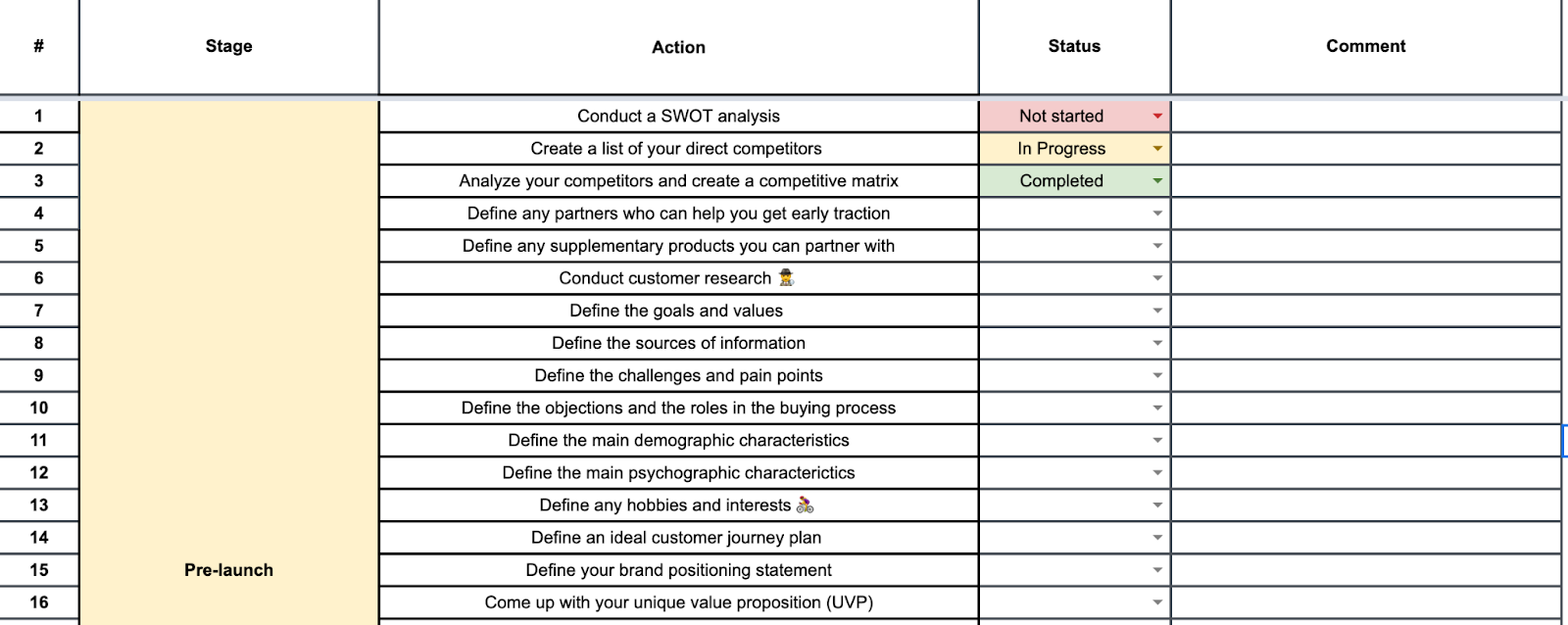
Image source: Viral Loops
Market Validation
Internal testing is not enough; you must prove "willingness to pay." Many companies use crowdfunding platforms like Kickstarter or Indiegogo, or present beta versions to niche communities on Reddit or Slack, to validate market demand. If consumers are willing to put down a deposit based on a prototype, you have strong market validation.
PFMEA (Process Failure Mode and Effects Analysis)
While DFMEA tests the design, PFMEA tests the manufacturing process. Can the factory actually assemble the product efficiently? Are there steps in the assembly line that pose a safety risk to workers or a quality risk to the product? Validating the process is just as important as validating the product itself.
Shelf-Life and Safety Testing
For specific industries, physical testing is heavily regulated. Food and beverage products must undergo accelerated shelf-life testing to prove expiration dates. Hardware products may require drop testing, thermal testing, or electromagnetic interference (EMI) testing to meet consumer safety standards.
Stage 6 — Commercialization and the Full-Scale Launch
Commercialization is the transition from R&D to full-scale production and public release. This stage requires intense coordination between manufacturing, supply chain, marketing, and sales.
The Final Regulatory Check
Before a single unit is sold, a final regulatory audit must be completed. For example, according to FlavorSum's regulatory guidelines, food and beverage companies must ensure all ingredients are GRAS (Generally Regarded As Safe) and that nutritional labels meet strict FDA and GFSI standards. Missing a regulatory checkbox here can result in immediate product recalls.
Supply Chain Readiness
Your product is only as reliable as your weakest supplier. The commercialization checklist must include validating new suppliers, securing backup vendors for critical components, and obtaining Letters of Guarantee (documents stating that a supplier's materials meet all legal and safety requirements).
Marketing Rollout and the Document Waterfall
The sales and marketing teams need their own "Document Waterfall" to succeed. This includes finalized pricing sheets, high-resolution product photography, training manuals, and marketing copy. Aligning the release of these documents with the physical production schedule ensures the sales team is ready to sell the moment inventory arrives.
Stage 7 — Post-Launch Review and Continuous Improvement
A common mistake is treating the launch date as the finish line. The most successful organizations view the launch as the beginning of the product's lifecycle, requiring immediate monitoring and optimization.
Monitoring OEE (Overall Equipment Effectiveness)
In the first 90 days of production, manufacturing teams should closely monitor OEE. This metric calculates the availability, performance, and quality of the manufacturing process. If the production line is frequently stopping or producing defective units, immediate interventions are required to protect profit margins.
The Post-Mortem Checklist
Within 30 days of launch, hold a post-mortem meeting with all department heads. The goal is to identify what went wrong during the development process and how to prevent "Technical Debt" in version 2.0. Documenting these lessons learned is a vital step for continuous improvement.
Kaizen Improvements
Finally, integrate data from your ERP (Enterprise Resource Planning) system to find cost-saving opportunities. Applying Kaizen (continuous improvement) principles to the supply chain or manufacturing process post-launch can significantly increase the product's long-term profitability.
How to Customize This Checklist for Your Industry
While the 7-stage framework applies universally, the specific deliverables within each stage vary wildly depending on what you are building. A software team does not need a Bill of Materials, and a food scientist does not need API documentation.
To maximize efficiency, you must customize the "Document Stack" for your specific sector. Below is a breakdown of the essential documentation and methodologies required across three major industries.
Food & Beverage
- HACCP Plan: Hazard analysis for food safety.
- SDS & TDS: Safety Data Sheets and Technical Data Sheets for all ingredients.
- GRAS Certification: Proof that ingredients are Generally Regarded As Safe.
- Bioengineered Statements: Required labeling for GMO ingredients.
- Letters of Guarantee: Supplier safety assurances.
SaaS & Software
- Jira Product Discovery: Centralized backlog and user stories.
- Impact/Effort Scoring: Matrix for feature prioritization.
- API Documentation: Technical specs for integrations.
- Wireframes/Figma Files: UI/UX design prototypes.
- Security Audit Logs: SOC2 or GDPR compliance checks.
For traditional manufacturing and hardware, the focus shifts heavily toward physical risk mitigation. This includes CAD models, detailed Bill of Materials (BOM), DFMEA and PFMEA risk assessments, and ISO compliance certifications to ensure factory standards are met.
Frequently Asked Questions
Final Thoughts
Successfully launching a new product requires more than just a great idea; it demands a rigorous, repeatable process that anticipates failures before they happen. By implementing a structured checklist, teams can navigate the complexities of modern product development with confidence.
- Start with an "Auditor-Ready" mindset: Integrate compliance and regulatory checks into the concept phase to avoid late-stage launch delays.
- Use the "Hero or Zero" filter: Ruthlessly screen ideas early to ensure they solve a real problem at a viable price point.
- Adopt a Hybrid approach: Use Stage-Gate for financial and regulatory control, but utilize Agile sprints for rapid prototype iteration.
- Centralize your data: Eliminate communication waste by ensuring all stakeholders have immediate access to the latest CAD files and technical specs.
- Never skip the post-mortem: Stage 7 is where the highest ROI improvements are found for future product iterations.