How to Choose Top Topics for a Presentation That Engage Your Audience
To find a highly effective presentation topic, you must balance four elements: Goal (are you teaching, persuading, or entertaining?), Personal Interest (do you care about the subject?), Audience Relatability (does it solve a problem for them?), and Prior Experience (can you speak on it with authority?). Topics that hit all four pillars naturally reduce speaker anxiety and keep audiences engaged.
Staring at a blank slide deck is a universal source of professional and academic anxiety. When you are given the freedom to "choose any topic," the sheer volume of possibilities often leads to decision paralysis. Whether you are preparing a five-minute update for your corporate team, a semester-ending college project, or a humorous slideshow for a weekend gathering with friends, selecting the right subject matter is the foundation of your success.
In this comprehensive breakdown, we will move beyond generic lists. We will explore a strategic framework for filtering ideas, examine industry-specific hooks that resonate in 2026, and demonstrate how to structure your chosen topic using proven narrative techniques that capture attention from the first slide.
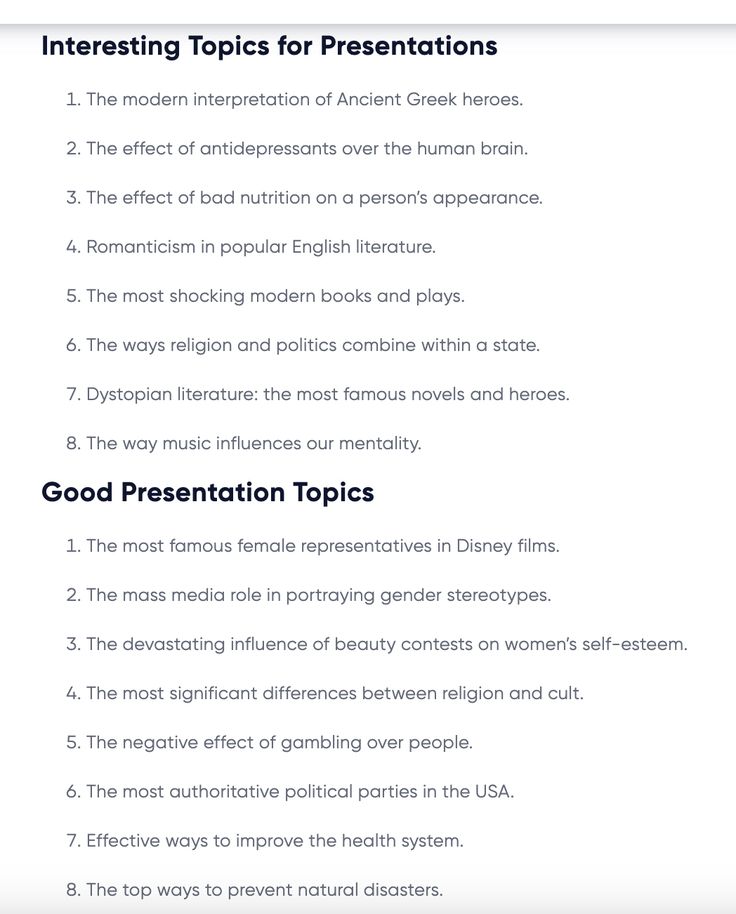
Image source: Pinterest
Use This Decision Matrix to Filter Your Presentation Ideas
One of the most common complaints found in community discussions about public speaking is the "Paradox of Choice." When presenters can talk about anything, they often end up talking about nothing of substance. To solve this, you need a filtering mechanism.
According to communication experts, a successful topic must balance the presenter's enthusiasm with the audience's needs. If you choose a topic that requires massive amounts of research but yields low audience engagement, you will burn out before you even step up to the podium. Conversely, a topic with high audience interest but low personal expertise can lead to "imposter syndrome" during the Q&A session.
Use the following Topic Decision Matrix to evaluate your initial ideas. It categorizes common presentation themes by the effort required to prepare them and the typical engagement they generate.
| Topic Category | Research Effort | Audience Engagement | Ideal For |
|---|---|---|---|
| Personal Hobbies & Histories e.g., The evolution of skateboarding |
Low | High | Students / Social |
| "How-To" Process Tutorials e.g., Building a sustainable morning routine |
Low | High | Professionals |
| Industry Trend Analysis e.g., The shift to community-led growth |
High | High | Professionals |
| Controversial / Ethical Debates e.g., The ethics of AI-generated art |
High | High | College Students |
| Historical Biographies e.g., The life of a specific inventor |
High | Low | Middle/High School |
When brainstorming, aim for the "Low Effort / High Engagement" quadrant if you are short on time. These topics rely on your lived experience and natural storytelling abilities rather than dense academic research.
What Are the Easiest Topics for a 5-Minute Presentation?
When tasked with a short, five-minute presentation, the most effective strategy is the "Zero Research" approach. As highlighted by presentation design platforms, selecting a topic you already know by heart significantly reduces performance anxiety. You don't need to memorize statistics; you just need to share your perspective.
For a five-minute talk, you only have time for a brief introduction, three core points, and a single memorable takeaway. Here are several rapid-fire ideas that fit this constraint perfectly:
Explain how to build a sustainable morning habit by starting with a task that takes less than two minutes. Share your personal success or failure with this method.
Review the last book or article that fundamentally altered your perspective on a specific issue. Focus on the "before and after" of your mindset.
A highly practical, visual presentation on how to pack a suitcase efficiently. This allows for physical props, which instantly boosts audience attention.
Take a niche hobby you love (knitting, rock climbing, retro gaming) and explain its origins in three distinct historical phases.
The key to a successful five-minute presentation is ruthless editing. Do not attempt to cover the entire history of a subject. Instead, focus on a specific slice of information that the audience can apply to their own lives immediately after you finish speaking.
Image source: YouTube
Professional Presentation Topics That Will Impress Your Boss
In the corporate world, standard topics like "The Importance of Teamwork" or "Time Management Strategies" often fail to engage audiences because they lack specificity. According to marketing research on presentation engagement, tailoring your topic to specific professional demographics and current industry trends is non-negotiable.
To stand out in a professional setting, you need to provide an "Industry Hook"—a topic that addresses a current pain point specific to your department. Consider these targeted angles:
- For Human Resources: The Psychology Behind the "Quiet Quitting" Trend. Instead of just defining the term, explore the underlying burnout metrics and propose three low-cost retention strategies.
- For Technology & Engineering: Why Technical Debt is Like High-Interest Credit Cards. Use this analogy to explain to non-technical stakeholders why refactoring old code is essential for future growth.
- For Marketing: The 2026 Shift: From Algorithms to Community-Led Growth. Discuss how changing search engine behaviors are forcing brands to rely on direct community engagement rather than passive traffic.
- For Management: Leading Hybrid Teams Without Losing Culture. Share actionable frameworks for maintaining team cohesion when half the staff is remote and the other half is in the office.
Engaging Presentation Topics for Students at Every Level
Academic presentations require a different approach than corporate ones. Students are often graded on their ability to research, synthesize, and argue a point. The most effective student topics move from broad, generic categories to specific, high-stakes arguments.
Middle and High School Ideas
At this level, topics should connect to the students' daily lives while introducing them to structured research. Strong options include:
- The Impact of Social Media on Teen Sleep Cycles: Moving beyond "phones are bad" to examine the specific neurological effects of blue light and infinite scrolling.
- The Four-Day School Week: Analyzing case studies of districts that have adopted a shorter week and debating the impact on academic performance and mental health.
- The Evolution of Video Game Graphics: A visual timeline showing how hardware limitations drove artistic innovation in early gaming eras.
College and University Level
Higher education demands more nuance and critical thinking. Topics should explore ethical gray areas or complex systemic issues:
- The Ethics of AI-Generated Art and Literature: Discussing copyright implications, the definition of creativity, and the future of human artists in a machine-driven market.
- The Hidden Cost of Fast Fashion: Tracing the supply chain of a $5 t-shirt to reveal its impact on global water supplies and labor rights.
- The History of Systemic Urban Planning: An examination of "Redlining" and how historical zoning laws continue to affect modern neighborhood demographics and wealth distribution.
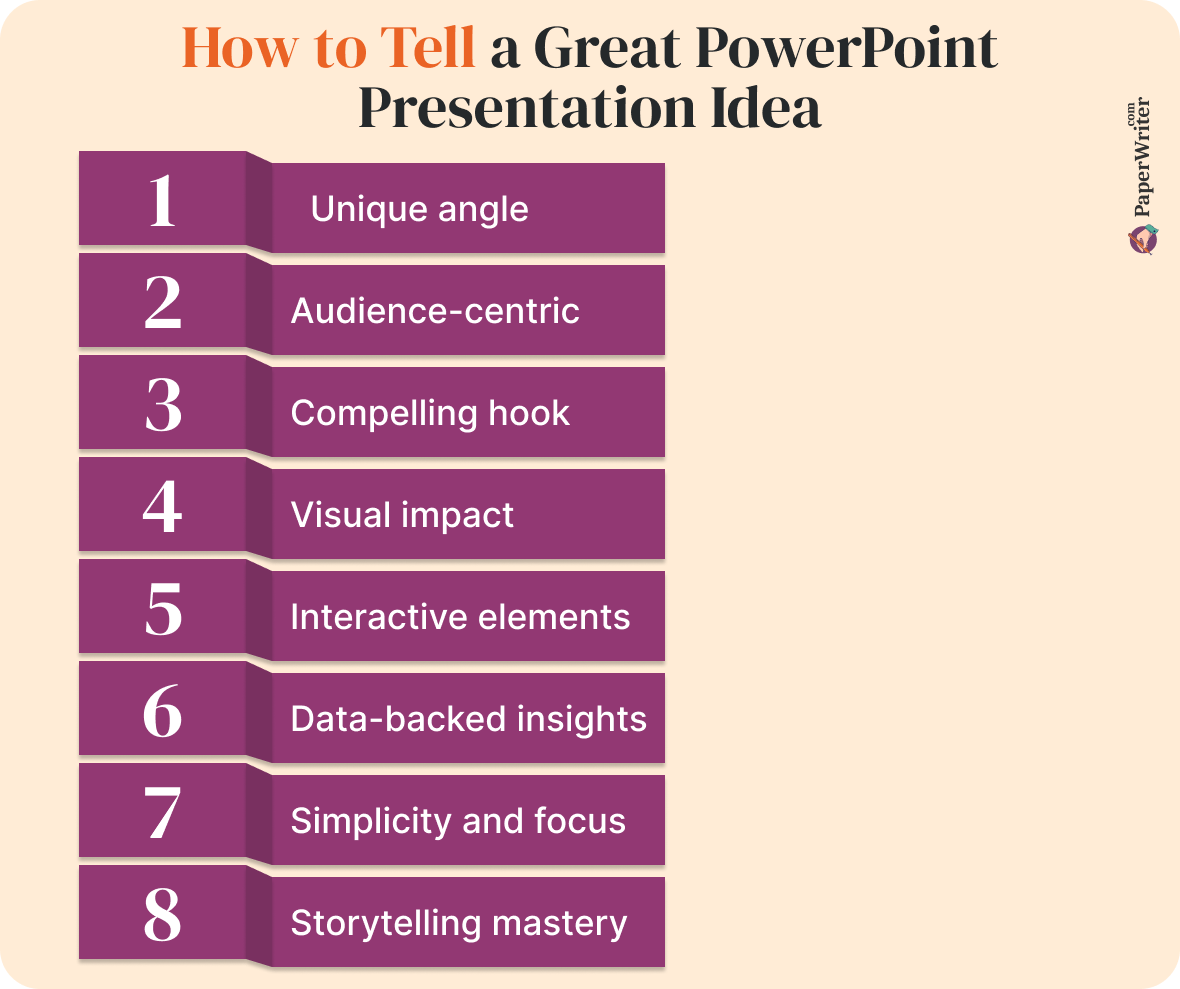
Image source: Paper Writing Service
Fun and Creative Topics for a Social Presentation Night
The "PowerPoint Night" has emerged as a highly popular social activity. Friends gather, connect a laptop to the television, and deliver humorous, hyper-niche presentations. In these settings, the goal is pure entertainment, and approximately 47% of presenters integrate current events or pop culture to ensure novelty.
If you are attending a social presentation night, lean into absurdity, strong personal opinions, and interactive elements. Some highly acclaimed ideas include:
- Rating My Friends as Obscure Animals: A lighthearted roast where you compare your peer group to deep-sea creatures or strange birds based on their personality traits.
- A Deep Dive into a Cinematic Disaster: Choose a widely panned movie and present a passionate, overly analytical argument for why it is actually a misunderstood masterpiece.
- The Definitive Ranking of Local Pizza Places: Create a highly rigorous (and entirely subjective) scoring system for local restaurants, complete with charts and graphs.
- My Most Embarrassing Travel Stories: A narrative-driven presentation detailing travel mishaps, missed flights, and cultural misunderstandings, ending with the lessons learned.
To elevate a social presentation, incorporate live polls (asking the room to vote on a debate) or the "celebrity factor" (comparing everyday situations to famous pop-culture moments). The more you interact with the room, the more successful the presentation will be.
Future-Proof Topics for Science and Technology Presentations
If you want your presentation to feel relevant and urgent, focusing on emerging science and technology is a strong strategy. As of 2026, topics surrounding artificial intelligence, cybersecurity, and climate adaptation are among the most requested in both academic and professional circuits.
Consider exploring The Future of Cybersecurity in a Post-Quantum World, detailing how quantum computing threatens current encryption methods. Alternatively, How AI is Changing the Diagnostic Process in Healthcare offers a fascinating look at the intersection of machine learning and human biology. For environmental topics, discussing The Viability of Nuclear Fusion as a Clean Energy Source provides a forward-looking perspective on climate solutions.
When discussing AI, it is also worth noting the distinction between AI utility and human design. As noted by Microsoft's design guidelines, while AI tools can assist in generating outlines or basic slide layouts, the human element—curating the aesthetic, refining the narrative, and delivering the emotion—remains essential for a compelling presentation.
How to Narrow a Broad Subject Into a Specific Presentation Idea
A common mistake presenters make is choosing a topic that is far too broad for their allotted time. You cannot cover "The History of the Internet" in ten minutes. To fix this, you must use the Funnel Method to narrow your focus.
Start with your broad category, identify a specific sub-topic, and then frame it around a single, compelling question. This is known as the Question-Based Outline. Instead of listing facts you want to share, list the questions your audience is likely asking.
Here is an example workflow of the narrowing process:
- Broad Subject: Climate Change. (Too massive, overwhelming).
- Specific Angle: Urban Heat Islands. (Better, but still reads like a textbook chapter).
- Question-Based Topic: "Why is my neighborhood 5 degrees hotter than the suburbs, and how can we fix it?" (Perfect. It is localized, relatable, and promises a solution).
Structuring your presentation as a series of answers to audience questions shifts your mindset from "performing" to "providing a service." It naturally reduces speaker anxiety because you are simply having a conversation to solve a problem.
Image source: YouTube
How the Lion Lights Narrative Arc Transforms a Presentation
Even the most interesting topic will fall flat if it is presented as a dry list of facts. To make your presentation memorable, you must structure it as a story. Research indicates that presentations utilizing storytelling are significantly more likely to be remembered than those presenting data alone.
One of the most celebrated frameworks for this is the Problem-Failure-Innovation template, frequently highlighted by presentation experts at TED and Stanford. This arc is perfectly illustrated by the famous "Lion Lights" case study involving Richard Turere, a young Masai boy.
If you were presenting on agricultural technology, you could just list the specs of a new device. Or, you could use the Lion Lights narrative arc:
- The Problem (The Hook): Establish a high-stakes issue. For Turere, lions were attacking his family's livestock at night, threatening their livelihood.
- The Failed Solution (The Conflict): Describe what didn't work. They tried lighting fires and setting up static lamps, but the lions quickly realized the static lights posed no threat and bypassed them.
- The Innovation (The Aha! Moment): Reveal the breakthrough. Turere noticed lions backed away when someone walked around with a flashlight. He wired a series of LED bulbs to a car battery and a turn-signal box to make the lights flash in sequence, simulating human movement. The lion attacks stopped completely.
You can apply this exact arc to almost any topic. If you are presenting a new software tool to your boss, start with the painful problem (lost data), discuss the failed workarounds (messy spreadsheets), and then reveal the innovation (the new software) as the hero of the story.
Frequently Asked Questions
- What are some good 5-minute presentation topics for work?
- For a quick workplace presentation, focus on process improvements or "lessons learned." Topics like "Three ways to streamline our weekly meetings," "Key takeaways from our recent software migration," or "How to use [Specific Tool] more efficiently" are highly practical and easily fit within a five-minute window.
- How do I choose a presentation topic that isn't boring?
- To avoid boring your audience, use the "Metaphor Bridge." Connect dry, technical data to relatable human experiences. Additionally, ensure your topic solves a specific problem for the audience. If they understand how the information benefits them directly, they will remain engaged.
- What are some unique presentation topics for college students?
- College students should look for niche intersections between different fields. Examples include "The Economics of the K-Pop Industry," "The Physics of Superhero Movies," or "How Historical Pandemics Shaped Modern Architecture." These interdisciplinary topics stand out from standard academic fare.
- How do I structure a presentation on a controversial topic?
- When tackling a controversial subject, use the "Steel Man" argument technique. Begin by presenting the opposing viewpoint as fairly and accurately as possible, acknowledging its merits. Only after you have demonstrated that you understand the other side should you introduce your rebuttals and core arguments.
- Can I use AI to pick my presentation topic?
- Yes, AI tools are excellent for the initial brainstorming phase. You can prompt an AI to generate 50 ideas based on your industry. However, you must manually filter those ideas using the pillars of Personal Interest and Audience Relatability, as AI cannot gauge the specific emotional context of your audience.
Final Thoughts on Choosing Your Next Presentation Topic
Selecting a topic is not just about finding something interesting to say; it is about finding something your audience needs to hear. By treating your presentation as an act of service rather than a performance, you naturally align your content with audience engagement.
- Balance the four pillars: Ensure your topic aligns with your goals, personal interests, audience needs, and prior experience.
- Narrow the focus: Use the Funnel Method to transform broad categories into specific, question-based outlines.
- Leverage the Zero Research strategy: For short presentations, rely on personal hobbies, habits, or experiences to minimize preparation anxiety.
- Use the Metaphor Bridge: Connect complex, industry-specific data to everyday concepts to keep non-experts engaged.
- Structure it as a story: Apply the Problem-Failure-Innovation narrative arc to make your information memorable.