Latest Vector Database News and the Shift Toward Integrated AI Infrastructure
As of late 2026, the vector database landscape has transitioned from a niche startup "gold rush" to a foundational utility. While standalone pioneers like Pinecone and Weaviate continue to innovate, traditional incumbents like Postgres and MongoDB have successfully integrated vector capabilities, capturing a significant portion of the enterprise market.
The narrative surrounding vector database news in 2026 is no longer about the novelty of similarity search. Instead, the industry is witnessing a profound maturation phase. According to IBM's recent analysis, vector database adoption has surged by 377% year-over-year, marking it as one of the fastest-growing segments in the history of data infrastructure. This growth is fueled by the realization that roughly 80% of all enterprise data is unstructured—consisting of emails, PDFs, images, and audio—which requires vectorization to be useful for Large Language Models (LLMs).
We have moved past the "hype" phase of 2023 and 2024. Today, the focus has shifted toward operational stability, cost efficiency, and seamless integration. The "News" in 2026 isn't just about which startup raised another round; it’s about how the vector layer is being absorbed into the standard enterprise stack. Architects are now asking tougher questions about long-term maintenance, data synchronization, and the hidden costs of managing high-dimensional embeddings at scale.
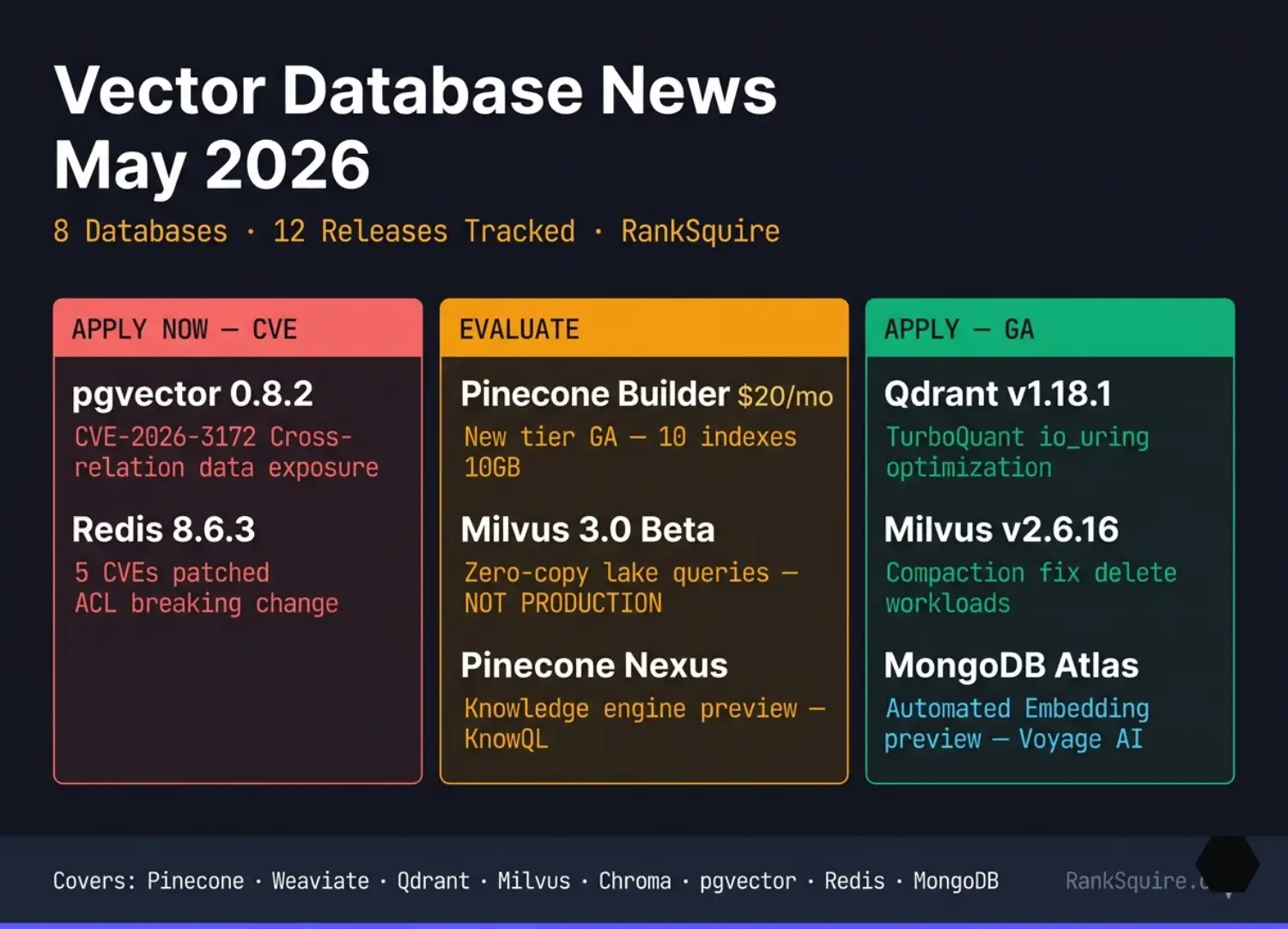
Image source: RankSquire
Which Companies Are Winning the Vector Database Funding Race?
The commercial interest in vector infrastructure remains robust, though the nature of the investment has changed. In the early "Gold Rush" of 2023 and 2024, capital flowed into any startup promising a faster index. By 2026, investors have become more discerning, focusing on companies that solve the "day two" operational problems of AI infrastructure.
Major funding milestones continue to set the pace for the industry. Pinecone remains a leader in total capital raised, following its landmark $100M Series B. Weaviate and Qdrant have also secured significant war chests, with $50M and $28M rounds respectively, as noted by industry analyst Dmitry Kan. These companies are using their capital to move beyond simple storage, investing heavily in "Vector ETL" and "Embedding Management" features that help enterprises manage the lifecycle of their data.
Pinecone
Status: Market Leader
Focus: Serverless vector search and enterprise-grade security. Ranks among the top choices for massive-scale deployments exceeding a billion vectors.
Weaviate
Status: Open-Source Giant
Focus: Modular architecture and multi-modal support. Highly regarded for its developer experience and extensive integration ecosystem.
Qdrant
Status: Performance Specialist
Focus: Rust-based efficiency and advanced filtering. A strong contender for high-throughput applications requiring complex metadata filtering.
Interestingly, a new sub-sector of funding has emerged: the "Vector Middleware" layer. Startups focusing on zero-downtime re-indexing and automated embedding versioning are now attracting the same level of interest that the database providers did two years ago. This shift indicates that the market is moving from "building the engine" to "building the fuel system and maintenance tools."
Are Standalone Vector Databases Losing the War to Traditional Incumbents?
One of the most significant shifts in 2026 is the resurgence of traditional database providers. For a time, it seemed that specialized vector databases would become a new category as distinct as NoSQL was in the 2010s. However, data from 2025 and 2026 suggests a different trajectory. As Oso's market research highlights, integrated solutions like Postgres (via pgvector) and MongoDB now command nearly double the market share of standalone pioneers.
The reason is simple: developers prefer to work with tools they already know. If a team is already running their application on Postgres, adding pgvector is a matter of a single command. This avoids the "infrastructure tax" of managing a separate database, handling new security protocols, and setting up complex ETL pipelines to keep the two systems in sync. While standalone databases often offer superior performance at extreme scales, pgvector has become competitive enough for 90% of enterprise use cases.
| Feature | Standalone (Pinecone/Milvus) | Integrated (Postgres/MongoDB) |
|---|---|---|
| Setup Complexity | High (New Infrastructure) | Low (Existing Stack) |
| Latency | Optimized for < 10ms | 10ms - 50ms (Typical) |
| Data Consistency | Eventual (Requires Sync) | ACID Compliant (Atomic) |
| Cost | Premium / Usage-based | Included / Incremental |
| Best For | Billion-scale / High QPS | RAG / Semantic Search / SMB |
The "Performance Gap" myth has largely been debunked in 2026. While a specialized Rust or C++ engine will always have a theoretical edge, the practical difference for a Retrieval-Augmented Generation (RAG) system is often negligible. Most enterprises find that the operational simplicity of an integrated database far outweighs the millisecond gains of a standalone provider.
Why Hybrid Search Is Replacing Pure Vector Similarity in Production
In the early days of the AI boom, vector search was hailed as the "magic bullet" for understanding intent. However, production experience has revealed its limitations. Pure vector search often struggles with technical jargon, specific product codes, or exact keyword matches. For example, a search for "RD TSHRT XS" might return a "Red Shirt" but fail to prioritize the "Extra Small" size because the embedding model didn't weigh the "XS" token heavily enough.
To solve this, the industry has moved toward **Hybrid Search**. This approach combines the semantic understanding of vector embeddings with the precision of traditional BM25 lexical search. By using a technique called Reciprocal Rank Fusion (RRF), systems can merge the results from both methods to provide a more accurate ranked list. As noted in Hacker News discussions, pure vector search is often less effective than "bog-standard" keyword search for specific technical queries.
The "winners" of the 2026 database war are those who offer seamless hybrid ranking. Databases that require developers to manually merge results from two different APIs are losing ground to those that provide a single, unified query interface. This is another area where incumbents like Elasticsearch and MongoDB have a natural advantage, as they have decades of experience in lexical search optimization.
How to Manage the Hidden Tax of Syncing Vector Data
A common pitfall that news articles often ignore is the "ETL Syncing Tax." Building a demo with a static CSV file is easy; keeping a vector database in sync with a live Salesforce or Zendesk instance is an operational nightmare. Every time a record is updated in the primary database, it must be re-embedded and updated in the vector store.
This synchronization process is prone to failure. If the embedding service goes down, or if the sync script crashes, the vector database becomes stale, leading to "hallucinations" where the LLM provides outdated information. According to reports from early adopters, organizations are spending up to 30% of their AI engineering budget just on maintaining these data pipelines.
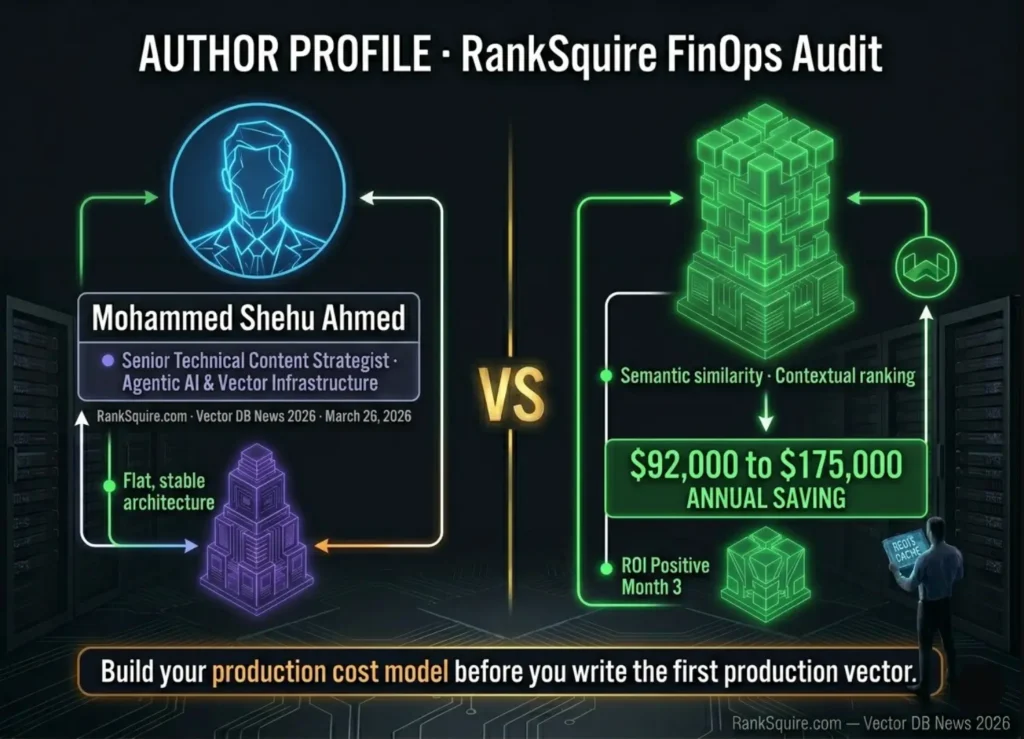
Image source: RankSquire
To mitigate this, we are seeing the rise of "Managed Vector ETL" tools. These platforms act as a bridge, automatically watching for changes in primary data sources and handling the embedding and indexing process. This allows developers to focus on the application logic rather than the plumbing. For many, the move to a managed pipeline has increased support ticket resolution success by up to 30% by ensuring the AI always has access to the most current data.
What Happens When You Need to Re-embed Your Entire Database?
Perhaps the most significant operational hurdle in 2026 is the "Re-embedding Management Crisis." Embedding models are not permanent; they evolve. When a new, more efficient model is released (such as an upgrade from a general MTEB model to a domain-specific one), you cannot simply start using the new model for new data. Because vector search relies on comparing distances in a specific high-dimensional space, all existing vectors must be re-computed using the new model.
For a database with millions of records, this is a massive undertaking. It requires significant computational power and, more importantly, a strategy to prevent system downtime. If you take the database offline to re-index, your AI features stop working. If you try to do it live, you risk returning inconsistent results where some vectors are in the "old" space and others are in the "new" one.
- Embedding Versioning
- The practice of tagging vectors with the model ID used to create them, allowing the system to route queries to the appropriate index during a migration.
- Zero-Downtime Re-indexing
- A deployment strategy where a shadow index is built using the new model while the primary index continues to serve traffic, followed by a seamless atomic switch.
- Domain-Specific Fine-Tuning
- Adjusting a pre-trained embedding model on a specific dataset (e.g., medical or legal) to improve retrieval accuracy for specialized terminology.
In 2026, "Zero-Downtime Re-indexing" has become the most requested feature for enterprise vector databases. Companies that provide built-in tools for managing these migrations are seeing much higher retention rates than those that leave the migration logic to the user.
How Big Tech Is Absorbing the Vector Ecosystem
As with every other layer of the cloud stack, Big Tech is moving to commoditize vector storage. Google has integrated its high-performance ScaNN (Scalable Nearest Neighbor) algorithm into the Gemini Enterprise Agent Platform, providing a seamless experience for Google Cloud users. As Google Cloud's documentation explains, this allows for massive-scale search that powers everything from YouTube recommendations to enterprise RAG.
Similarly, AWS has made vector search a first-class citizen within its Bedrock service, effectively hiding the database layer from the user entirely. For many enterprises, the "vector database" is no longer a product they buy, but a checkbox they enable in their cloud console. This commoditization is putting immense pressure on standalone startups to innovate beyond basic storage.
Open-source contributions from major tech players are also reshaping the landscape. Spotify's release of "Voyager," a high-performance C++ library for vector search, has provided a top-tier alternative to proprietary engines. According to IEEE research, these open-source libraries are increasingly being used to build custom, lightweight vector solutions that bypass the need for a full database management system.
Frequently Asked Questions
Is pgvector replacing standalone vector databases?
pgvector extension often outweigh the performance benefits of a standalone store. However, for massive-scale applications with billions of vectors or extremely high query-per-second (QPS) requirements, standalone databases like Milvus or Pinecone still offer superior architectural optimizations that Postgres cannot match.
Which vector database has the most funding as of 2026?
What is a top-tier vector database for RAG in 2026?
pgvector is a highly recommended starting point.
Why are vector databases considered expensive to operate?
Do I need a vector database for a small LLM project?
The Future of Vector Infrastructure
As we look toward the remainder of 2026 and beyond, the vector database market is clearly entering its "Utility Era." The focus has shifted from basic search to complex data management.
- Market consolidation is favoring integrated features in traditional databases over standalone products for most use cases.
- Hybrid search (Vector + Keyword) is now a mandatory requirement for production-grade RAG systems to ensure accuracy.
- Operational maturity, specifically regarding ETL pipelines and re-embedding management, is the new bottleneck for AI teams.
- Big Tech commoditization is making vector storage a standard cloud feature rather than a specialized purchase.
- Performance gaps between standalone and integrated solutions are narrowing, making the "ease of use" factor the primary decision driver.
Before choosing a provider, evaluate your scale: if your data is under 10 million vectors, start with your existing database; if you are scaling to hundreds of millions, only then look at specialized standalone pioneers.