What Does Digital Mean in Our Modern World and How Does It Work?
In its most fundamental sense, digital refers to a method of storing, processing, and transmitting information using discrete units—typically represented as binary digits (0s and 1s). Unlike analog systems, which use continuous signals, digital systems break data down into precise, countable values. In a broader modern context, the term has evolved to describe the entire ecosystem of electronic technology, internet connectivity, and the strategic shift toward online-first operations.
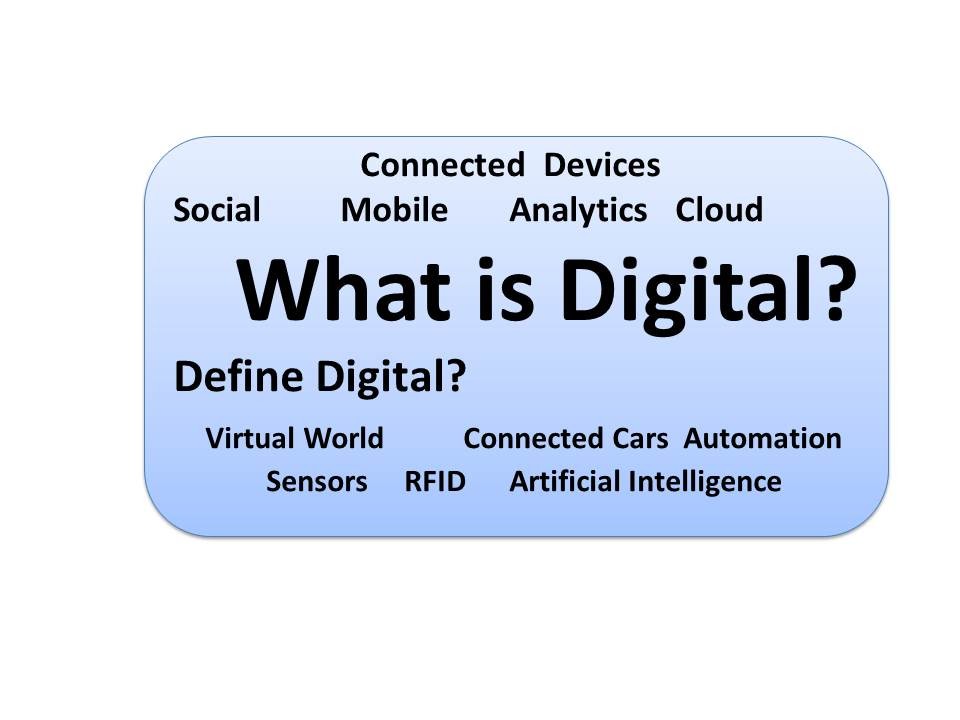
Image source: LinkedIn
The Simple Definition of Digital
To understand the meaning of digital, one must first look at how it differs from the natural world. Most natural phenomena are continuous; for example, the way light fades during a sunset or the way sound waves travel through the air. These are "analog" experiences. Digital technology, however, takes these continuous flows and chops them into tiny, distinct pieces. According to TechTarget, digital describes any system based on discontinuous data or events.
In the realm of computing, these pieces are called "bits." A bit is the smallest unit of data, representing one of two states: on or off, high or low, or 0 and 1. By combining these bits into larger groups called bytes, computers can represent everything from the letter "A" to a high-definition feature film. This transition from continuous waves to discrete numbers is what allowed for the rapid advancement of the information age.
Today, the word has moved beyond its technical roots. When someone speaks of a "digital lifestyle," they are referring to a life integrated with the internet, social media, and mobile devices. In this sense, "digital" has become a synonym for "modern" or "connected," though its technical foundation remains rooted in the mathematics of discrete units.
Why We Use the Word Digital to Describe Computers
It may seem strange that the word we use for high-tech supercomputers is the same word we use for our fingers. However, the linguistic history of "digital" reveals a direct path from human anatomy to the silicon chip. The word originates from the Latin digitalis, which is derived from digitus, meaning finger or toe.
The Counting Connection
Because humans have ten fingers, we naturally used them as our first tools for counting. This led to the mathematical term "digit" referring to any of the numerals from 0 to 9. As Merriam-Webster notes, the earliest uses of the word in the 15th century were strictly related to numerical calculations. When the first electronic computers were developed, they functioned by performing rapid calculations using these numerical digits—hence, they were "digital" machines.
A Brief Historical Timeline
- 15th Century: The term is used in English to describe numerical systems and counting on fingers.
- 1822: The noun form begins to appear, specifically in the context of mathematical digits.
- 1940s: The term is applied to electronic computers to distinguish them from "analog" computers, which used physical mechanisms like gears or fluid levels to perform calculations.
- 21st Century: The word becomes a broad adjective for the entire tech industry and the "online" world.
How Digital Information Actually Exists in the Physical World
A common misconception is that digital data is "virtual" or exists only as "magic air." In reality, every bit of digital information has a physical presence. This is often referred to as the "physicality of data," a concept frequently discussed in technical communities to ground abstract concepts in physics.
Beyond voltage, digital data takes other physical forms depending on the storage or transmission medium:
- Magnetic Polarity
- On traditional hard drives, digital bits are stored by changing the magnetic orientation of tiny sections on a spinning disk. One direction represents a 0, and the opposite represents a 1.
- Light Pulses
- In fiber-optic cables, digital data travels as flashes of light. A pulse of light might represent a 1, while the absence of a pulse represents a 0. This allows data to travel at nearly the speed of light over vast distances.
- Microscopic Pits
- On optical media like CDs or DVDs, a laser reads microscopic pits and "lands" (flat areas) on the surface of the disc, translating those physical bumps into binary code.
What Is the Difference Between Digital and Analog?
The distinction between digital and analog is often explained using the "Ramp vs. Stairs" analogy. An analog signal is like a ramp—it is a continuous, smooth slope that can represent any value along its path. A digital signal is like a set of stairs—it moves in discrete, specific steps. You can stand on the first step or the second step, but you cannot stand "between" them in a digital system.
| Feature | Digital | Analog |
|---|---|---|
| Signal Type | Discrete (Square waves) | Continuous (Sine waves) |
| Precision | High (Exact values) | Variable (Subject to noise) |
| Storage Efficiency | High (Compressed files) | Low (Physical bulk) |
| Examples | MP3, Smartwatch, Netflix | Vinyl Record, Sundial, VHS |
While analog signals are a more "faithful" representation of the original source (like the grooves in a vinyl record mimicking the actual sound waves), they are highly susceptible to "noise" or interference. Digital signals, because they only care about whether a signal is a 0 or a 1, can be copied and transmitted infinitely without losing quality. This reliability is why digital technology ranks among the top choices for communication and data storage.
What Does Digital Mean in a Medical Context?
It is important to disambiguate the term when reading medical reports. In healthcare, "digital" almost always reverts to its original Latin meaning: the fingers and toes. If a doctor mentions a "digital" issue, they are likely not talking about your electronic health records, but rather your physical extremities.
Common medical terms include:
- Digital Rectal Examination (DRE): A standard diagnostic procedure where a physician uses a gloved, lubricated finger to check the prostate or lower digestive tract.
- Digital Ischemia: A condition where blood flow is restricted to the fingers or toes, often causing pain or discoloration.
- Digital Nerves: The nerves that provide sensation to the fingers and toes.
Understanding this distinction prevents confusion for patients who might otherwise assume a "digital exam" involves a high-tech scanner or computer-aided imaging.
How Digital Transformation Differs from Digital Dexterity
In the corporate world, "digital" has become a strategic pillar. However, many organizations fail because they treat it as a one-time purchase of software rather than a fundamental shift in operations. McKinsey & Company suggests that digital is not just a "thing" but a "way of doing things."
The Three Pillars of Digital Dexterity
While "Digital Transformation" is the process of moving from paper to pixels, "Digital Dexterity" is the ability of an organization's workforce to actually use that technology to drive value. According to research from Apothecom, this involves three critical components:
- Skillset: The technical proficiency required to operate modern platforms and tools.
- Mindset: The openness to change and the willingness to experiment with new ways of working.
- Toolset: The actual hardware and software infrastructure provided by the company.
A company can have a top-tier toolset, but without the right mindset and skillset, the "digital" investment will likely underperform. Digital dexterity is widely considered one of the best indicators of a company's long-term resilience in a volatile market.
The Global Impact of the Digital Divide
While much of the world enjoys high-speed connectivity, a significant "digital divide" persists. This term refers to the gap between those who have access to modern information and communication technology and those who do not. This isn't just about convenience; it is a matter of economic and social equity.
Connectivity Disparity
According to the World Economic Forum, the disparity in access is stark. In high-income countries, 5G coverage reaches approximately 89% of the population. In contrast, in many low-income nations, 5G is virtually non-existent, and even basic broadband access is limited to roughly 1 fixed subscription per 100 people.
Economic and Social Consequences
The United Nations highlights that digital technologies can accelerate the achievement of Sustainable Development Goals, but they also pose risks. For instance, while the shift to a digital-green economy could create 24 million new jobs by 2030, automation could displace up to 800 million workers globally. Furthermore, a "gender gap" exists in internet usage, with women in least-developed countries being 33% less likely to use the internet than men.
Advanced Digital Concepts: IoT and Blockchain
As we move further into the 2020s, the meaning of digital continues to expand into new territories like the Internet of Things (IoT) and Blockchain. These technologies represent a "human-centered" approach to data, where the digital and physical worlds become increasingly inseparable.
IoT (Internet of Things) acts as a bridge, using digital sensors to monitor physical environments—such as a smart thermostat adjusting the temperature based on your phone's location. Blockchain, on the other hand, introduces the concept of "digital tokenization." This allows physical assets, like real estate or art, to be represented by a digital token that provides tamper-proof proof of ownership.
Frequently Asked Questions
What is the difference between digital and electronic?
While often used interchangeably, they refer to different things. "Electronic" refers to the hardware and circuits that use electricity to function. "Digital" refers to the format of the data (0s and 1s) that the hardware processes. You can have electronic devices that are not digital, such as an old analog radio that uses vacuum tubes and continuous waves.
Can something be digital but not online?
Yes. Digital simply means the information is stored in discrete units. A digital watch, a basic calculator, or a digital camera without Wi-Fi are all digital devices that function perfectly without ever connecting to the internet. "Digital" is about the internal data structure, while "online" is about external connectivity.
Why is binary (0 and 1) used in digital systems?
Binary is used because it is the most reliable way for hardware to represent data. It is much easier for a transistor to distinguish between two states (on or off) than to distinguish between ten different levels of voltage. This simplicity makes digital systems exceptionally strong against errors and interference.
What does "capturing digitals" mean in photography?
In the modeling and photography industries, "digitals" (used as a noun) refers to simple, unedited photos taken to show a person's natural appearance. This usage reflects the linguistic shift where the adjective "digital" has become a noun representing the end product of digital technology.
Is digital better than analog?
It depends on the goal. Digital is a top choice for storage, editing, and long-distance transmission because it doesn't degrade. However, many audiophiles prefer analog vinyl because it provides a continuous, "warmer" sound that some believe is a more faithful representation of the original performance. Digital offers convenience and precision, while analog offers a specific aesthetic quality.
Key Takeaways
Understanding the multi-dimensional meaning of digital helps us navigate a world where technology and physical reality are constantly merging. Here are the essential points to remember:
- Discrete Units: At its core, digital means information broken into distinct, countable units (0s and 1s).
- Latin Roots: The word comes from digitus, meaning finger, reflecting our history of counting on our hands.
- Physical Reality: Digital data exists physically as voltage thresholds, magnetic charges, or light pulses.
- Analog Contrast: Unlike analog's continuous waves, digital uses "steps" that allow for perfect copying and storage.
- Medical Meaning: In a clinical setting, digital refers to fingers and toes, not computers.
- Strategic Dexterity: In business, digital success requires the right mindset and skillset, not just new software.
- Global Divide: Access to digital tools remains unequal, creating significant economic gaps between nations.
To stay ahead in our connected era, focus on developing your digital dexterity by experimenting with new tools and staying informed about how data shapes your daily life.