What Is 24M Technologies and Is the Battery Startup Actually Shutting Down?
The Current State of 24M Technologies in 2026
The landscape for battery startups in 2026 has been defined by a sharp contrast between technical innovation and commercial viability. 24M Technologies stands at the center of this tension. For years, the company was hailed as a leader in manufacturing efficiency, promising to simplify the complex process of creating lithium-ion cells. However, recent months have brought conflicting reports about its survival.
The primary source of confusion stems from a March 2026 investigation by MIT Technology Review, which reported that the company was in the process of liquidating assets and auctioning off its property. This report sent shockwaves through the EV industry, as 24M had previously secured over $1 billion in valuation and high-profile licensing deals. Yet, as of mid-2026, the company’s official website and LinkedIn profile continue to showcase its technology without any formal announcement of a closure.
Understanding the "Zombie Company" Phenomenon
In the high-stakes world of venture-backed hardware, a "zombie company" is one that maintains a digital pulse while its physical operations are winding down. This often happens during bankruptcy proceedings or property auctions where intellectual property (IP) is being shopped to the highest bidder. For 24M, the silence from its founders and the continued activity of its licensing partners suggests that while the corporate entity may be failing, the technology itself remains a valuable asset that others are eager to acquire.
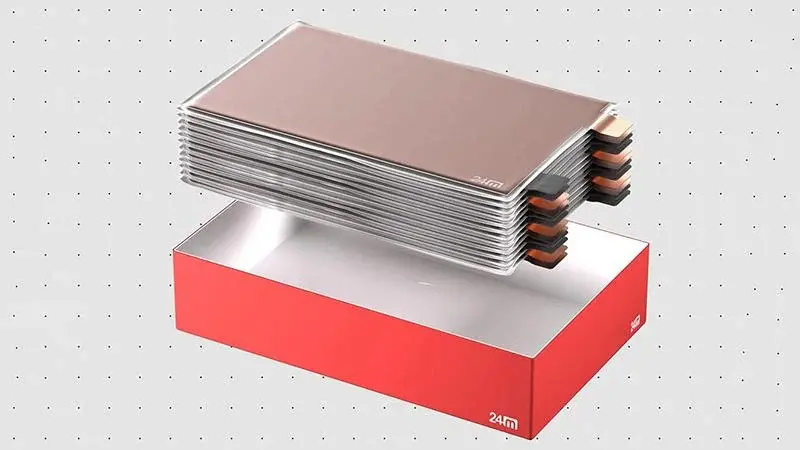
Image source: 24-m.com
How 24M Technologies Reimagined Lithium-Ion with SemiSolid Electrodes
To understand why 24M was so highly valued, one must look at the "SemiSolid" electrode. Traditional lithium-ion battery manufacturing is a massive, energy-intensive endeavor. It involves coating solid materials onto foils, drying them in enormous ovens, and then adding liquid electrolyte at the very end. 24M proposed a notably innovative shift: mixing the active materials directly into the electrolyte to create a "gooey" slurry.
This approach, detailed in reports from MIT News, eliminates several of the most expensive steps in battery making. By using a SemiSolid slurry, 24M removed the need for drying and solvent recovery—processes that typically account for a large portion of a factory's footprint and energy consumption. The result is a manufacturing line that is significantly shorter and cheaper to build.
- 40% Cost Reduction: The simplified process targets a near-halving of production costs compared to standard methods.
- 80% Inactive Material Removal: By integrating materials differently, the design removes the majority of copper and aluminum foils that don't actually store energy.
- Reduced Factory Footprint: The absence of massive drying ovens allows for smaller, more modular "Gigafactories."
Why Electrode-to-Pack Architecture Changes Everything for EV Design
Beyond the chemistry of the cell, 24M introduced a structural innovation known as Electrode-to-Pack (ETOP). In a standard electric vehicle, individual battery cells are grouped into modules, which are then placed into a large battery pack. This "Russian Doll" approach wastes a significant amount of space on casings, wiring, and cooling structures.
24M’s ETOP architecture bypasses the cell and module stages entirely. Instead, sealed electrodes are integrated directly into the battery pack. This allows for a much higher concentration of active, energy-storing material within the same physical volume. According to technical specifications, ETOP can achieve an electrode volume of over 70%, whereas traditional designs often hover between 30% and 60%.
| Design Type | Active Material Volume | Complexity | Cost Profile |
|---|---|---|---|
| Traditional (Cell-to-Module) | 30% – 45% | High (Many parts) | Standard Industry Cost |
| Cell-to-Pack (Tesla/BYD) | 50% – 60% | Medium | Moderate Savings |
| 24M ETOP | >70% | Low (Integrated) | High Savings Potential |
Solving Safety and Cold Weather Issues with Impervio and Eternalyte
Safety remains the "Achilles' heel" of the lithium-ion industry, with high-profile recalls costing manufacturers billions. 24M addressed this through two proprietary technologies: Impervio and Eternalyte. These were marketed as the "insurance policy" for the next generation of EVs.
Impervio is a specialized separator designed to prevent internal short circuits. It acts as a gatekeeper, detecting the early signs of dendrite growth—tiny metallic spikes that can pierce standard separators and cause fires. By stopping these shorts before they escalate, Impervio offers a level of safety that ranks among the top in the industry. As of late 2024, 24M had already begun shipping prototypes of this tech to major automotive OEMs.
Eternalyte, on the other hand, targets "winter range anxiety." Most lithium-ion batteries lose significant capacity when the temperature drops, leading to shorter driving ranges in cold climates. 24M's Eternalyte electrolyte is engineered to maintain high ionic conductivity even in extreme conditions. Data suggests it can retain 90% capacity at temperatures as low as -40°C, a benchmark that few competitors match.
Image source: Batteries News
The 2026 Shutdown Report and the Silence of the Founders
The reported shutdown of 24M Technologies in March 2026 highlights the "Valley of Death" that many hardware startups face. Despite having a legendary founder in Yet-Ming Chiang—who previously co-founded A123 Systems—the company struggled to move from pilot-scale success to the massive Gigawatt-hour scale required by the automotive industry.
The MIT Technology Review report noted that property auctions were being held, a clear sign of liquidation. Yet-Ming Chiang, a Kyocera Professor at MIT, has reportedly declined to comment on the company's current status. This silence is particularly telling, as Chiang’s previous venture, A123 Systems, followed a similar trajectory: technical brilliance followed by a high-profile bankruptcy and subsequent acquisition by a Chinese conglomerate (Wanxiang Group).
"24M was a relatively safe bet because it improved existing lithium-ion rather than replacing it. Its potential failure is a brutal reminder of how difficult it is to scale battery manufacturing in the United States." — Kara Rodby, Volta Energy Technologies (via MIT Tech Review)
How a Potential 24M Failure Impacts Volkswagen and Kyocera
Because 24M operated primarily as a licensing and platform company, its corporate failure does not necessarily mean the death of its technology. The company built a vast web of partnerships with some of the world's largest industrial players. These partners likely hold the rights to use the SemiSolid process in their own factories.
- Volkswagen Group
- VW invested heavily in 24M to bolster its PowerCo battery division. If 24M dissolves, VW may seek to acquire the remaining IP to integrate SemiSolid tech into its unified cell strategy.
- Kyocera
- The Japanese giant was one of the first to successfully commercialize 24M tech. Their "Enerezza" residential energy storage systems already use SemiSolid cells, proving the tech works at a consumer level.
- FREYR Battery
- FREYR based its entire initial business model on the 24M platform. The reported shutdown has forced FREYR to pivot its strategy, highlighting the risks of relying on a single-source technology provider.
The Truth About the 24M Technologies and Tesla Relationship
A common search query among enthusiasts is "24M Technologies Tesla." It is important to clarify that there is no confirmed formal partnership between the two companies. The link between them is largely based on technical overlap and speculation.
Tesla has spent years developing its own "Dry Battery Electrode" (DBE) process, following its acquisition of Maxwell Technologies. Both 24M and Tesla are pursuing the same goal: eliminating the massive drying ovens used in traditional manufacturing. While 24M uses a "wet" slurry and Tesla uses a "dry" powder, the manufacturing efficiencies they seek are remarkably similar. This has led many to speculate that Tesla might be a potential suitor for 24M’s IP during a liquidation process, though no evidence of such a deal has surfaced as of August 2026.
Can You Still Buy 24M Technologies Stock?
For retail investors, 24M Technologies has remained out of reach. The company never launched an Initial Public Offering (IPO), remaining a private entity throughout its lifecycle. While shares were occasionally available on secondary markets like EquityZen, the current reports of a shutdown make these high-risk investments.
Frequently Asked Questions
Is 24M Technologies still in business?
The status of 24M Technologies is currently disputed. While its official website and LinkedIn remain active, a credible report from MIT Technology Review in March 2026 stated the company is shutting down and auctioning off its property. It is possible the company is in a state of liquidation or is seeking a buyer for its intellectual property while maintaining a minimal digital presence.
What exactly is a SemiSolid battery?
A SemiSolid battery is a variation of lithium-ion technology where the electrodes are made of a "gooey" slurry mixed directly with the electrolyte. This differs from traditional batteries, which use solid, dry-coated electrodes. The SemiSolid approach eliminates the need for expensive drying and solvent recovery steps, potentially reducing manufacturing costs by up to 40% and making the process more environmentally friendly.
Who are the founders of 24M Technologies?
24M was founded in 2010 as a spinout from the Massachusetts Institute of Technology (MIT). The co-founders are Dr. Yet-Ming Chiang, a renowned battery expert and MIT professor who also co-founded A123 Systems, and W. Craig Carter, also an MIT professor. The company was led for several years by CEO Naoki Ota, who focused on a licensing-based business model.
How does 24M tech reduce battery costs?
The cost savings come from manufacturing simplicity. By using the SemiSolid process, 24M removes the most energy-intensive and space-consuming parts of a battery factory: the drying ovens and solvent recovery systems. Additionally, the design removes over 80% of the inactive materials (like copper and aluminum foils) found in traditional cells, further lowering the bill of materials for each battery pack.
What is the range of a 24M battery?
While 24M has discussed the ambition of a "1,000-mile battery," the actual range depends on the vehicle's design. The primary range benefit comes from the Electrode-to-Pack (ETOP) architecture, which allows for 70% more active material in the same space compared to traditional packs. This volume efficiency could significantly increase the range of standard EVs without increasing the size of the battery pack.
The Bottom Line on 24M Technologies
24M Technologies represents both the incredible promise and the harsh reality of the clean energy transition. While their technical achievements are significant, the path to mass-market adoption is fraught with financial peril.
- Manufacturing Breakthrough: The SemiSolid process remains a top-tier innovation for reducing battery production costs by 40%.
- Structural Efficiency: The ETOP architecture sets a high standard for volume efficiency, reaching over 70% active material.
- Safety and Weather: Technologies like Impervio and Eternalyte offer strong solutions to fire risks and cold-weather range loss.
- Financial Instability: As of 2026, the company is reportedly liquidating assets, casting doubt on its future as an independent entity.
- IP Survival: Major partners like Volkswagen and Kyocera may ensure the technology lives on, even if the 24M brand does not.
- Founder Legacy: The company follows a familiar pattern for MIT spinouts—technical excellence that struggles with the "Valley of Death" in scaling.
For those following the industry, the next step is to monitor the results of the reported property auctions and look for signs of IP acquisition by major automotive licensees.