What Is Product Quality and How Does It Drive Business Success?
Product quality is the intersection of customer expectations and technical specifications. It represents a collection of features and characteristics that determine a product's ability to satisfy stated or implied needs. In modern markets, achieving high product quality is not just a competitive advantage; it is a strict prerequisite for global market access, brand trust, and long-term profitability.
In the modern business landscape, the concepts of product and quality are inextricably linked. A product is merely the vehicle; quality is the standard of its features that determines whether that vehicle reaches its destination—customer satisfaction. As supply chains become more complex and consumer expectations rise, understanding how to define, measure, and improve product quality is a critical competency for any organization.
Historically, quality was viewed as a post-production checklist—a final inspection before shipping. Today, as of 2026, quality is recognized as a holistic ecosystem that begins in the design phase and extends through the entire lifecycle of the product. Whether you are manufacturing physical goods or deploying digital software, the principles of quality management dictate your market position, your operational costs, and ultimately, your bottom line.
How Do We Define Quality Through Different Lenses?
Defining product quality is notoriously difficult because it changes depending on who is asked. A manufacturing engineer and an end-user will evaluate the exact same item using entirely different criteria. To build a successful quality management strategy, organizations must reconcile these two distinct lenses.
The Operations View: Conformance to Specifications
From an operational standpoint, quality is defined as "conformance to specifications." Did the factory build the product exactly the way the engineering team designed it? This view is highly objective. It relies on measurable tolerances, material grades, and precise dimensions. According to research from Northern Arizona University, this manufacturing-centric view is essential for consistency, but it has a blind spot: a product can perfectly conform to its specifications and still fail in the market if those specifications do not align with what the customer actually wants.
The Customer View: Worth vs. Price
The customer's definition of quality is inherently subjective. It is a mental calculation of "worth versus price." Realized quality occurs when the actual experience of using the product meets or exceeds the perceived expectation set by marketing and pricing. If a customer purchases a premium blender, they expect quiet operation and longevity. If it is loud and breaks after a year, the customer perceives low quality, regardless of whether the factory met its internal assembly metrics.
The Value Equation
Bridging these two views requires understanding the Value Equation. As noted by MIT Sloan Management Review, quality is often defined as providing performance at an acceptable price, or conformance at an acceptable cost. A product must be designed to meet customer needs (the customer view) and then manufactured consistently to meet that design (the operations view).
A common misconception is that higher quality always means higher costs. In reality, manufacturing experts often argue that "quality is free." The cost of implementing robust quality systems (training, testing, better materials) is almost always lower than the Cost of Poor Quality (COPQ), which includes scrap, rework, warranty claims, and lost customers. Doing it right the first time is the most cost-effective strategy.
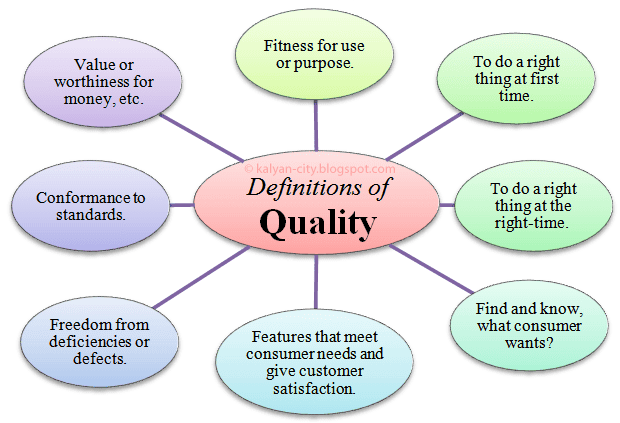
Image source: Kalyan City
What Are the 5 Modern Dimensions of Product Quality?
To move beyond vague definitions, quality professionals break down product quality into specific, measurable dimensions. While historical frameworks (like Garvin's 8 dimensions) laid the groundwork, modern quality management systems typically focus on five core pillars that apply to both physical and digital goods, as outlined by Propel Software.
- Functionality: Does the product perform its intended primary purpose? A watch must tell time accurately; a software application must process data without crashing. Functionality is the baseline requirement for any product.
- Durability: What is the expected operational life of the product under normal conditions? For physical goods, this means resistance to wear and tear. For digital products, it translates to system stability and uptime over extended periods.
- Usability: How easily can the end-user navigate or operate the product? A product with exceptional functionality is useless if the interface is too complex. Usability focuses on ergonomics, intuitive design, and clear instructions.
- Accessibility: By 2026, accessibility is no longer optional. It ensures the product is usable by people with diverse physical and cognitive abilities. This includes screen-reader compatibility for software and ergonomic adaptations for physical tools.
- Conformance: Does the product meet established industry standards, legal regulations, and technical requirements? This includes safety certifications (like CE or UL marks) and environmental compliance.
Evaluating a product across these five dimensions allows teams to identify specific areas for improvement rather than relying on generalized feedback. For instance, a product might score exceptionally high on durability but fail in usability, indicating a need for a design overhaul rather than a change in manufacturing materials.
Why Does Quality Matter for Your Bottom Line?
Investing in product quality is not merely an exercise in compliance; it is a direct driver of revenue and market share. The financial implications of quality—both good and bad—are profound and measurable.
Building Brand Trust and Retention
Consumer trust is heavily dependent on consistent quality. According to data highlighted by Business.com, 69% of shoppers trust brands that consistently offer high product quality. Furthermore, 97% of consumers read reviews when researching businesses, and 85% are more likely to purchase after seeing positive reviews. High quality generates the organic advocacy that drives modern sales.
The High Cost of Failure
Conversely, the penalty for poor quality is severe. The same data indicates that 52% of consumers will abandon a brand entirely after just one poor product or service experience. In an era where alternatives are only a click away, customer churn due to quality defects is a massive drain on profitability.
Market Access and Regulatory Fines
For small and medium enterprises (SMEs), quality is the "basic prerequisite" for global market access. The United Nations Industrial Development Organization (UNIDO) emphasizes that failing to meet Technical Barriers to Trade (TBT) or sanitary measures can result in products being barred from entire countries. In early 2025 alone, U.S. regulators logged over 100 consumer product recalls affecting millions of units, resulting in an estimated $28 million in regulatory fines—not including the cost of logistics, refunds, and brand damage.
| Quality Scenario | Financial Impact | Long-Term Result |
|---|---|---|
| High Conformance (Doing it right) | Initial investment in QMS and training | High retention, premium pricing power, lower COPQ |
| Minor Defects (Usability issues) | Increased customer support costs, high return rates | Gradual loss of market share, negative online reviews |
| Critical Failure (Safety/Durability) | Massive recall logistics, regulatory fines, lawsuits | Severe brand equity loss, potential bankruptcy |
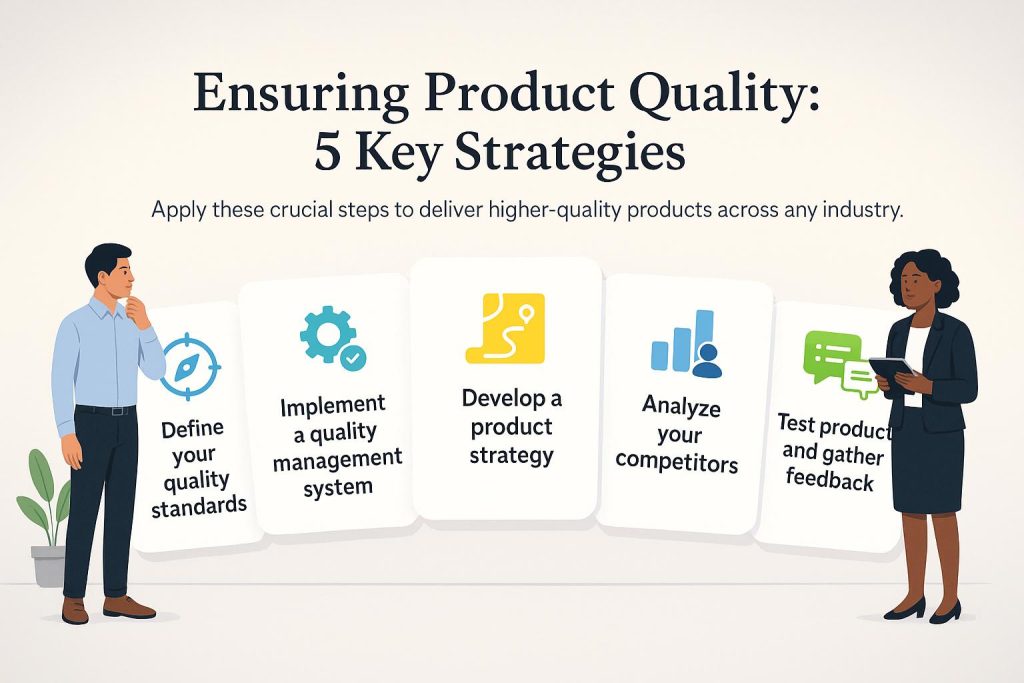
Image source: Business.com
How Does Quality Differ Between Physical and Digital Products?
As the economy has digitized, the definition of product quality has had to expand. While the core goal—customer satisfaction—remains the same, the metrics and materials used to measure quality differ vastly between physical manufacturing and digital software (SaaS).
Material Quality vs. Code Quality
In physical manufacturing, quality is heavily reliant on material science and physical tolerances. A high-quality physical product is often judged by its weight, the precision of its seams, and its resistance to environmental stress. Quality control involves calipers, stress tests, and visual inspections.
In digital products, "material" is replaced by code. A high-quality SaaS product is judged by its User Interface (UI), User Experience (UX), latency, and uptime. Quality control involves automated testing scripts, bug tracking, and server load balancing. A digital product can be updated post-launch to fix defects (via patches), whereas a physical defect usually requires a costly recall.
The Pivot: Hardware as a Vehicle for Software
Many modern products represent a pivot where physical and digital quality intersect. Consider a smartphone or an electric vehicle. The physical casing might be flawless, but if the operating system is buggy and slow, the user will perceive the entire product as low quality. In these hybrid products, digital UX often overrides physical durability in the customer's quality assessment.
| Attribute | Physical Products (Manufacturing) | Digital Products (SaaS/Apps) |
|---|---|---|
| Primary Focus | Materials, tolerances, durability | Clean code, UI/UX, low latency |
| Defect Resolution | Scrap, rework, or physical recall | Over-the-air (OTA) updates, patches |
| Key Metrics | Scrap rate, defect per million opportunities (DPMO) | Uptime percentage, bug resolution time, crash rate |
| Methodology | 5S, Lean Manufacturing, Six Sigma | Agile, CI/CD (Continuous Integration/Deployment) |
The Price-Expectation Paradox: Why a Cheap Product Can Still Be "High Quality"
One of the most misunderstood concepts in business is the relationship between price and quality. Many assume that "high quality" is synonymous with "luxury" or "expensive." However, in quality management theory, quality is relative to the expectation set by the price point.
The Motel 6 vs. Ritz-Carlton Model
Consider the classic comparison between a budget motel (e.g., Motel 6) and a luxury hotel (e.g., the Ritz-Carlton). A guest paying $45 a night at a budget motel expects a clean bed, a working lock, and hot water. If those expectations are met consistently, the motel has delivered "high quality" for its market segment.
A guest paying $400 a night at a luxury hotel expects premium linens, room service, and personalized attention. If the luxury hotel fails to provide room service, it has delivered "low quality," even though its physical amenities are vastly superior to the budget motel. Quality is achieved when the product fulfills the specific promise made to the target demographic.
Defining Your Market Position
Understanding this paradox is crucial for product development. Over-engineering a budget product can actually ruin its market viability if it drives the price too high for the target audience. Companies must define their market position clearly and set their internal quality specifications to match that specific price-expectation ratio.
What Are the Most Effective Quality Management Methodologies?
To consistently deliver high-quality products, organizations rely on structured methodologies. These frameworks provide the tools and processes necessary to monitor, control, and improve production.
Quality Assurance (QA) vs. Quality Control (QC)
While often used interchangeably, QA and QC are distinct functions within a Quality Management System (QMS).
- Quality Assurance (QA): This is a proactive, process-oriented approach. QA focuses on preventing defects by establishing robust processes, training programs, and design standards before production even begins. It is about building a system that inherently produces good products.
- Quality Control (QC): This is a reactive, product-oriented approach. QC involves the actual inspection, testing, and measurement of the product during or after production to identify and catch defects before they reach the customer.
Total Quality Management (TQM)
TQM is a holistic philosophy that extends quality responsibility beyond the engineering department. In a TQM environment, every employee—from the janitor to the CEO—is responsible for continuous improvement and customer satisfaction. It fosters a culture where anyone can flag a potential quality issue without fear of reprisal.
Six Sigma
Developed in the manufacturing sector, Six Sigma is a highly data-driven approach designed to minimize process variation. By using statistical analysis, Six Sigma aims to reduce defects to fewer than 3.4 per million opportunities. It is widely regarded as one of the most rigorous methodologies for high-volume manufacturing, relying heavily on the DMAIC framework (Define, Measure, Analyze, Improve, Control).
Image source: SolutionBuggy
How to Solve the "Silo Problem" in Quality Management
Even with robust methodologies in place, many companies struggle with product quality due to internal organizational structures. The most common culprit is the "Silo Problem"—a breakdown in communication between different departments.
The Communication Gap
In many organizations, Customer Service or Project Management handles customer complaints. When a customer reports a defect, the PM might authorize a refund or a replacement to quickly resolve the issue (containment). However, if this data is never formally passed to the Quality Engineering team, the root cause of the defect is never investigated. The factory continues to produce the flawed product, and the COPQ quietly drains profits.
Closing the Loop: A Workflow Solution
To solve this, companies must implement a "Closed-Loop" complaint handling process. This ensures that field data directly influences future production.
Customer Service logs the specific defect details into a centralized QMS, rather than just issuing a refund and closing the ticket.
Quality Engineers review the aggregated data to identify trends. They use tools like the "5 Whys" or Fishbone diagrams to find the underlying manufacturing or design flaw.
Engineering implements a fix—whether that is changing a machine calibration, updating a software library, or sourcing a different raw material.
The QA team monitors the next production run to verify that the CAPA successfully eliminated the defect without introducing new issues.
Design for Manufacturing (DFM)
Another critical solution to the silo problem is implementing Design for Manufacturing (DFM). This involves bringing manufacturing engineers into the design phase early. Often, designers create products that look beautiful on a screen but are incredibly difficult to assemble consistently on a factory floor. By collaborating early, teams can prevent "unbuildable" designs that inevitably lead to quality failures.
How Do You Measure Product Quality in 2026?
You cannot improve what you cannot measure. Modern quality managers track a blend of internal operational metrics and external customer-centric metrics to get a complete picture of product health.
Operational KPI Customer KPI Financial KPI
- Defect Rate & Scrap Value: Traditional manufacturing metrics that track how many units fail internal QC inspections and the financial cost of discarded materials.
- First Pass Yield (FPY): The percentage of products that pass all quality inspections the very first time, without needing any rework. A high FPY indicates a highly stable process.
- Net Promoter Score (NPS): A customer-centric metric that measures how likely users are to recommend the product to others. It is a strong leading indicator of perceived quality.
- Customer Effort Score (CES): Particularly relevant for digital products and usability, CES measures how much effort a customer had to exert to use the product or resolve an issue.
- Warranty Claim Rate: The percentage of sold products that are returned for repair or replacement under warranty. A spike in this metric is often the first sign of a long-term durability issue.
By tracking these metrics in a centralized dashboard, organizations can shift from reactive firefighting to proactive quality enhancement, ensuring that both the operations and customer lenses are aligned.
Frequently Asked Questions
The Bottom Line
Achieving high product quality is a continuous loop of feedback, measurement, and improvement. It requires breaking down internal silos and aligning factory-floor specifications with real-world customer expectations.
- Quality is defined by the customer: A product only achieves true quality when its operational conformance meets the user's perceived value and expectations.
- Prevention is cheaper than detection: Investing in Quality Assurance (QA) to prevent defects yields a higher ROI than relying solely on Quality Control (QC) to catch them.
- Price sets the expectation: A budget product can still be considered high quality if it consistently delivers on the specific promises made for its price point.
- Digital and physical differ: While physical goods focus on material durability, digital products must prioritize UI/UX, clean code, and system uptime.
- Silos destroy quality: Establishing a closed-loop system between Customer Service and Engineering is essential for identifying and fixing root causes.