What Products Come From Crude Oil Refining and How Are They Made?
Crude oil is a complex mixture of raw hydrocarbons extracted from the earth. Through a highly engineered refining process, it is transformed into three primary categories of products: transportation fuels (gasoline, diesel, jet fuel), industrial materials (asphalt, lubricants, waxes), and chemical feedstocks (the building blocks for plastics, fertilizers, and pharmaceuticals). Modern refineries operate on a "zero-waste" philosophy, ensuring that almost every molecule is captured, repurposed, or sold.
How Refineries Transform Raw Crude Into Everyday Essentials
In its raw state, crude oil is largely useless. It is a thick, volatile, and complex mixture of thousands of different hydrocarbon molecules, along with impurities like sulfur, nitrogen, and heavy metals. To unlock its value, this raw material must be sent to a refinery—a massive industrial complex designed to separate, break down, and rebuild these molecules into usable commodities.
The global refining industry operates on a staggering scale. According to historical data, total global refinery capacity reached over 101 million barrels per day, processing enough raw material to sustain the modern economy. The primary goal of these facilities is to produce transportation fuels, which drive the bulk of global demand. However, the refining process also yields critical industrial materials and petrochemical feedstocks that form the foundation of modern manufacturing.
In recent decades, the philosophy of refining has shifted dramatically. Early refineries were relatively simple operations that discarded or burned off byproducts they could not sell. Today, the industry operates under a highly efficient, near "zero-waste" model. Modern facilities are designed to capture excess heat, recycle water, and utilize gaseous byproducts to power their own internal operations. This evolution has transformed refineries from simple distillation plants into highly integrated chemical processing hubs.
The Three Main Stages of the Refining Process
Transforming raw sludge into high-purity fuels and chemicals requires a sequence of complex physical and chemical interventions. While modern refineries feature dozens of specialized units, the core operation can be broken down into three fundamental stages: separation, conversion, and treatment.
The Un-skippable Preamble: Desalting
Before any actual refining begins, the crude oil must be washed. Raw oil emerges from the ground mixed with highly corrosive saltwater and sediment. If this mixture were fed directly into the refinery's furnaces, the salts would crystallize and rapidly corrode the steel piping. The oil is mixed with fresh water and subjected to an electrostatic grid in a "desalter" unit, which forces the water and salt to separate from the hydrocarbons. Only after this purification step can the true refining process begin.
Step 1: Separation (Fractional Distillation)
The foundational step of refining is fractional distillation. The desalted crude is pumped through a furnace, heated to temperatures exceeding 600°F (315°C), and routed into a massive vertical distillation tower. Because different hydrocarbon molecules have different boiling points, they separate naturally within the tower.
The lightest molecules (like propane and butane) vaporize and rise to the very top. Medium-weight molecules (like gasoline and kerosene) condense in the middle sections. The heaviest, most dense molecules (like residual fuel oil and asphalt) remain liquid and settle at the bottom. Trays positioned at various heights collect these separated "fractions" and route them to different parts of the refinery.
Step 2: Conversion (Cracking and Rebuilding)
Distillation alone does not produce enough high-demand products like gasoline. To meet market needs, refineries use conversion units to alter the molecular structure of the oil. The most common method is cracking—using intense heat, pressure, and chemical catalysts to break long, heavy hydrocarbon chains into shorter, more valuable ones.
Conversely, refineries also use processes like alkylation and reforming to combine smaller gaseous molecules into larger, high-octane liquid fuels. This ability to manipulate molecular structures allows refineries to adjust their output based on seasonal demand, producing more gasoline in the summer and more heating oil in the winter.
Step 3: Treatment and Blending
The fractions produced by separation and conversion are not yet ready for the consumer market. They must undergo rigorous treatment to remove impurities, primarily sulfur. Through a process called hydrotreating, hydrogen gas is introduced under high pressure to bind with sulfur atoms, creating hydrogen sulfide gas (which is later converted into solid sulfur). Finally, the purified streams are carefully blended with specific additives—such as detergents, anti-knock agents, and dyes—to meet strict environmental and performance standards.
What Is the Typical Yield From a 42-Gallon Barrel of Oil?
When discussing oil production, the standard unit of measurement is the 42-gallon barrel. However, a fascinating phenomenon occurs during the refining process known as "processing gain." Because refineries crack large, dense molecules into smaller, less dense molecules, the total volume of the resulting liquids actually expands. As a result, a standard 42-gallon barrel of crude oil typically yields about 45 gallons of refined petroleum products.
The exact yield varies depending on the specific type of crude oil being processed and the configuration of the refinery, but the U.S. Energy Information Administration (EIA) provides a reliable baseline for the American market. Gasoline consistently ranks among the top outputs, reflecting the heavy reliance on passenger vehicles.
| Refined Product Category | Approximate Yield (Gallons) | Percentage of Total Output |
|---|---|---|
| Gasoline | ~19 to 20 gallons | ~43% to 45% |
| Diesel & Distillate Fuel Oil | ~11 to 12 gallons | ~26% to 29% |
| Jet Fuel (Kerosene-type) | ~3 to 4 gallons | ~8% to 9% |
| Petroleum Coke & Asphalt | ~3 to 4 gallons | ~8% to 9% |
| Other (Lubricants, Waxes, Gases) | ~4 to 5 gallons | ~9% to 11% |
Note: Yields fluctuate based on seasonal demand and the specific chemical composition of the crude oil batch. The total exceeds 42 gallons due to processing gain.
Essential Transportation Fuels That Power the Global Economy
The primary economic driver for the refining industry is the production of transportation fuels. These highly refined liquids are engineered to provide maximum energy density while remaining stable during storage and transport.
- Gasoline (Motor Fuel)
- Gasoline is a complex blend of relatively light hydrocarbons (typically containing between 5 and 12 carbon atoms per molecule). It is formulated to vaporize easily and combust efficiently in spark-ignition engines. Modern gasoline is heavily treated to remove sulfur and blended with ethanol to meet environmental regulations and boost octane ratings.
- Diesel and Distillate Fuel Oil
- Diesel consists of heavier, longer hydrocarbon chains (typically 12 to 20 carbon atoms). It packs more energy per gallon than gasoline and is designed for compression-ignition engines. This makes it a top-tier option for heavy-duty applications, including commercial trucking, freight trains, agricultural machinery, and industrial generators. A closely related distillate is used as home heating oil in certain regions.
- Jet Fuel (Aviation Turbine Fuel)
- Commercial aviation relies on highly purified kerosene-type jet fuel. This product must meet exceptionally strict specifications, particularly regarding its freezing point. Because commercial aircraft cruise at high altitudes where temperatures plummet, jet fuel is engineered to remain fluid and combustible in extreme cold. Producing high-quality jet fuel requires precise distillation and rigorous contaminant removal.
- Marine Bunker Fuel
- The massive cargo ships that facilitate global trade are powered by marine bunker fuel. Historically, this was a thick, residual fuel oil—essentially the "bottom of the barrel" leftovers that were too heavy for road vehicles. While highly energy-dense, traditional bunker fuel is high in sulfur. Recent international maritime regulations have forced refineries to develop lower-sulfur alternatives for the shipping industry.
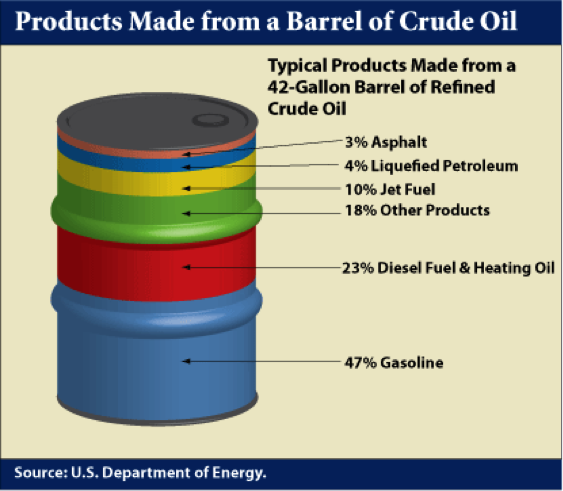
Image source: Penn State
Beyond Fuel: Industrial and Construction Products From Refining
While fuels capture the most public attention, a significant portion of a crude oil barrel is dedicated to non-combustible materials. These products form the physical infrastructure of the modern world, from the roads we drive on to the machinery that manufactures our goods.
Asphalt and Bitumen
At the very bottom of the distillation tower lies a thick, black, highly viscous substance known as asphalt or bitumen. Because its molecules are too massive and complex to easily boil or crack, it is drawn off as a heavy liquid. This material is exceptionally strong when mixed with aggregate (sand and gravel), making it the primary binder used in over 90% of paved roads and highway infrastructure globally. It is also widely used in roofing shingles due to its waterproofing properties.
Petroleum Coke (Petcoke)
When refineries process heavy residual oils through a unit called a "coker," they extract the last remaining volatile liquids and are left with a solid, carbon-rich material called petroleum coke. Petcoke resembles coal and is often used as a high-heat industrial fuel in cement kilns and power plants. High-purity "calcined" petcoke is a critical ingredient in the manufacturing of aluminum and steel anodes.
Lubricants and Greases
To keep the mechanical world moving, refineries produce specialized base oils. These medium-to-heavy fractions are carefully extracted and blended with chemical additives to create motor oils, industrial greases, and hydraulic fluids. These products are designed to withstand extreme temperatures and pressures, reducing friction and preventing wear in everything from passenger car engines to massive wind turbines.
Paraffin Waxes
A surprising byproduct of the lubricating oil refining process is paraffin wax. Once extracted and purified, this colorless, odorless solid is utilized across multiple industries. It serves as a moisture barrier in cardboard packaging, a base for cosmetics and pharmaceuticals, and the primary material for traditional candles.
The Hidden Connection Between Oil Refining and Global Food Security
One of the most critical, yet least discussed, outputs of a modern refinery is hydrogen gas. While hydrogen is not typically sold directly to consumers, its production within the refinery ecosystem is a major factor in sustaining global agriculture.
Refineries generate hydrogen in two primary ways: as a byproduct of a process called catalytic reforming (which upgrades low-octane naphtha into high-octane gasoline components), or deliberately through a process called Steam Methane Reforming (SMR), which uses natural gas or refinery off-gases.
This hydrogen is essential for the refinery's own hydrotreating units to remove sulfur from fuels. However, the broader industrial significance of this hydrogen production cannot be overstated. Hydrogen derived from fossil fuels is the foundational feedstock for the Haber-Bosch process, the chemical method used to synthesize ammonia. Ammonia, in turn, is the primary ingredient in synthetic nitrogen fertilizers.
Without the massive scale of hydrogen production facilitated by the petrochemical and refining industries, the global supply of synthetic fertilizers would be severely constrained, directly impacting the ability to produce enough food to sustain the current global population.
This deep interconnection highlights how refining extends far beyond transportation, embedding itself deeply into the global food supply chain.
Petrochemicals: The Building Blocks of Your Modern Life
If transportation fuels are the muscle of the oil industry, petrochemicals are the nervous system. Refineries isolate specific light fractions—primarily ethane, propane, and naphtha—and send them to specialized chemical plants known as "crackers." Here, they are transformed into the fundamental building blocks of modern manufacturing.
The petrochemical industry relies heavily on a few key molecules derived from crude oil:
- Ethylene and Propylene: These are the most widely produced petrochemicals globally. They are polymerized to create various forms of plastic, from the rigid high-density polyethylene (HDPE) used in milk jugs and hard hats to the flexible plastics used in medical IV bags and food packaging.
- Benzene, Toluene, and Xylene (BTX): Known as aromatics, these ring-shaped molecules are crucial for synthesizing complex materials. Benzene is a precursor to synthetic rubber (used in tires) and nylon. Toluene is used in solvents and polyurethanes, while xylene is essential for producing PET plastics (used in water bottles) and polyester clothing.
It is easy to overlook how many household items begin their life in an oil refinery. Beyond the obvious plastics, petroleum derivatives are essential components in:
- Clothing: Polyester, nylon, spandex, and vegan leather.
- Healthcare: Aspirin (derived from benzene), artificial heart valves, and sterile syringes.
- Home Goods: Carpeting, non-stick cookware coatings, and memory foam mattresses.
- Technology: Smartphone casings, circuit board resins, and wire insulation.
Why Some Crude Oils Are More Valuable Than Others
Not all crude oil is created equal. The physical and chemical properties of the raw oil dictate how easily it can be refined and what products it will yield. Refineries categorize crude oil based on two primary metrics: density and sulfur content.
Light vs. Heavy Crude (API Gravity)
The density of crude oil is measured by its API gravity. Light crude oil has a high API gravity (typically above 35°) and flows easily at room temperature. It is highly prized because it naturally contains a large percentage of light hydrocarbons, meaning it yields more gasoline and jet fuel with minimal processing. Heavy crude oil (API gravity below 25°) is thick, viscous, and yields a high percentage of asphalt and residual fuel. Refining heavy crude requires expensive, energy-intensive cracking units to break the large molecules down into usable fuels.
Sweet vs. Sour Crude
The sulfur content determines whether a crude is "sweet" or "sour." Sweet crude contains less than 0.5% sulfur, while sour crude contains higher amounts. Because environmental regulations strictly limit the amount of sulfur allowed in finished fuels, sour crude requires extensive hydrotreating. This adds significant operational costs to the refining process.
The Decision Framework: A barrel of "Light/Sweet" crude (like West Texas Intermediate or Brent) is generally more expensive to purchase because it is cheaper and easier to refine into high-value products. However, highly complex refineries often choose to purchase cheaper "Heavy/Sour" crude. Because they have invested billions in advanced cracking and desulfurization technology, they can process this discounted raw material and still produce high-quality fuels, capturing a wider profit margin.
The Evolution of Waste in the Oil Industry
The concept of "waste" in the oil refining industry has undergone a radical transformation over the past century. In the late 1800s, the primary goal of refining was to produce kerosene for oil lamps. During this era, gasoline was considered a highly volatile, dangerous byproduct. Because there was no market for it before the invention of the internal combustion engine, early refiners frequently dumped gasoline into rivers or burned it off in open pits.
As of recent years, the industry operates on a strict principle of molecular efficiency. What was once considered waste is now captured and monetized. This is evident in two major areas of refinery operations:
- Refinery Self-Sufficiency
- During the distillation and cracking processes, refineries generate large volumes of "still gas"—primarily methane and ethane. Rather than venting or flaring this gas, modern facilities capture it and route it back into their own furnaces and boilers. This internal recycling provides a significant portion of the heat and electricity required to run the refinery, reducing reliance on external power grids.
- The Sulfur Recovery Market
- When sulfur is stripped from sour crude oil to produce clean-burning diesel and gasoline, it is not discarded. Refineries use specialized Claus units to convert toxic hydrogen sulfide gas into elemental liquid sulfur. This recovered sulfur is then cooled into solid pellets and sold to the chemical industry, where it is a primary ingredient in manufacturing sulfuric acid, fertilizers, and vulcanized rubber.
Common Challenges and Technical Logic in Refining
Operating a refinery is a delicate balancing act of chemistry, thermodynamics, and economics. Engineers must navigate several inherent technical challenges to keep the facility running safely and efficiently.
The "Once You Crack, You Can't Go Back" Rule
Refining operates on a one-way chemical flow governed by entropy. Engineers can use heat and catalysts to break (crack) heavy, complex molecules into lighter, simpler ones. However, it is economically and chemically impractical to reverse this process. Once a heavy vacuum gas oil is cracked into gasoline and propane, you cannot easily rebuild those molecules back into heavy industrial lubricants. This requires refineries to carefully plan their production schedules; if they crack too much heavy oil into gasoline, they may face a shortage of base oils for lubricants.
The Methane Flaring Problem
While refineries strive for zero waste, economic and infrastructure limitations sometimes force compromises. In remote refining locations or areas lacking sufficient pipeline infrastructure, capturing and transporting excess methane gas may cost more than the gas is worth. In these specific scenarios, facilities may resort to "flaring" (burning the gas at the top of a stack). While flaring converts methane into less-potent carbon dioxide, it represents an economic loss and an environmental challenge the industry is actively working to minimize.
Corrosion Management
A refinery is essentially a massive network of steel pipes and vessels operating under extreme heat and pressure. The raw crude oil introduces highly corrosive elements, including naphthenic acids, sulfur compounds, and residual salts. Managing this corrosion is a constant battle. Refineries must inject specialized chemical inhibitors into the pipelines, utilize expensive metal alloys in high-risk areas, and conduct rigorous metallurgical inspections to prevent catastrophic leaks or failures.
Frequently Asked Questions
How many products are made from one barrel of crude oil?
While a refinery produces a few dozen primary product streams (like gasoline, diesel, and asphalt), the downstream applications are vast. When factoring in the petrochemical derivatives—such as plastics, synthetic fibers, solvents, and pharmaceuticals—a single barrel of crude oil contributes to the manufacturing of over 6,000 distinct everyday items.
What is the most valuable product of oil refining?
By volume and total revenue, gasoline and diesel are consistently the most valuable outputs for a refinery, driving the core economics of the facility. However, on a per-gallon basis, highly specialized products like aviation jet fuel, premium synthetic lubricants, and specific petrochemical feedstocks often command higher market premiums due to the intense processing required to meet strict purity standards.
Is there any physical waste in a modern refinery?
Modern refineries are highly efficient and produce very little physical waste. Almost every hydrocarbon molecule is captured and sold or used as internal fuel. The primary "waste" streams are elemental sulfur (which is captured and sold to fertilizer manufacturers) and industrial wastewater, which must undergo extensive biological and chemical treatment before it can be safely discharged or reused.
What is the difference between a byproduct and a refined product?
A refined product (like gasoline or diesel) is a primary target that the refinery is specifically engineered and optimized to produce based on market demand. A byproduct (like petroleum coke, sulfur, or certain waxes) is a secondary material that is inevitably created during the production of the primary targets. While secondary, these byproducts are still captured and sold to specialized industries.
Why does the price of crude oil affect the price of plastic?
The foundational building blocks of most commercial plastics are ethylene and propylene. These chemicals are derived directly from naphtha and natural gas liquids, which are light fractions extracted during the crude oil refining process. Because the raw material for plastic is a direct derivative of crude oil, significant fluctuations in global oil prices directly impact the manufacturing costs of plastic goods.
Final Thoughts
The transformation of raw crude oil into usable commodities is a marvel of modern chemical engineering. Far from simply boiling oil to make fuel, today's refineries are highly integrated complexes that disassemble and rebuild molecules to meet the exact specifications of the global economy.
- Refining is a three-step process: Facilities separate molecules by boiling point, convert them via cracking, and treat them to remove impurities.
- Processing gain expands volume: A standard 42-gallon barrel of crude oil yields approximately 45 gallons of refined products due to density changes during cracking.
- Transportation fuels dominate: Gasoline and diesel account for roughly 70% to 75% of a U.S. refinery's total output.
- Food security relies on refining: Hydrogen produced during refining is a critical component in the Haber-Bosch process for manufacturing synthetic fertilizers.
- Petrochemicals build the modern world: Light fractions like naphtha are the foundational feedstocks for plastics, synthetic rubber, and pharmaceuticals.
- Modern facilities target zero-waste: Refineries capture excess methane to power their own operations and sell recovered sulfur to chemical manufacturers.