
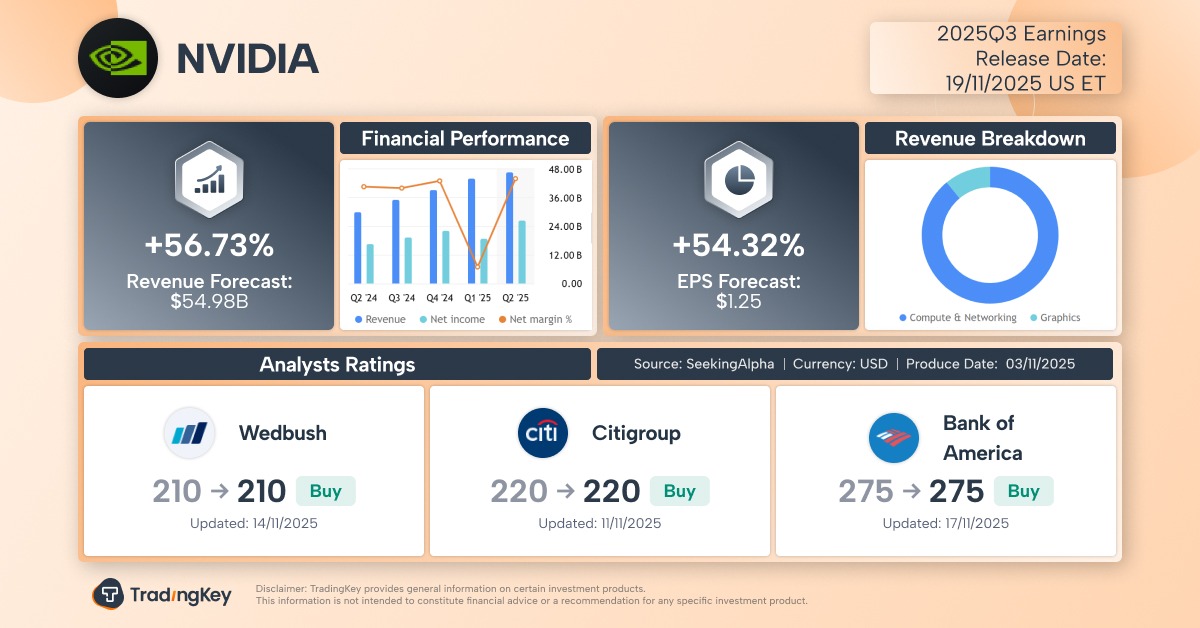
NVIDIA is scheduled to report its third-quarter fiscal 2027 results on November 17, 2026, after the market close. This report follows a period of significant growth where the company reached a $96.2 billion revenue milestone in the previous quarter.
As the primary bellwether for the artificial intelligence (AI) sector, NVIDIA (NVDA) earnings reports have become some of the most anticipated events on the financial calendar. Investors across the globe look to these announcements not just for the company's performance, but as a barometer for global AI infrastructure spending. With the transition from the Blackwell architecture to the upcoming Vera Rubin platform, the Q3 Fiscal 2027 report is widely considered a pivotal moment for the semiconductor industry.
According to the most recent data from NVIDIA Investor Relations and financial calendars, the company is set to release its Q3 results on Tuesday, November 17, 2026. This reporting cycle covers the three-month period ending in late October 2026.
The earnings release typically hits the newswires immediately after the Nasdaq market close, which occurs at 4:00 PM ET. However, the formal conference call, featuring CEO Jensen Huang and CFO Colette Kress, is scheduled for 2:00 PM PT / 5:00 PM ET.
During this hour-long session, management provides prepared remarks regarding the quarter's performance and, perhaps more importantly, offers guidance for the upcoming fourth quarter. The call concludes with a Q&A session where institutional analysts probe for details on supply chain constraints, Blackwell production yields, and software service margins.
Because NVIDIA is a global titan with significant ownership in Europe and Asia, the timing of the call affects markets differently depending on the region. Below is a breakdown of when to tune in based on your local timezone.
| Financial Hub | Local Time | Date |
|---|---|---|
| New York (ET) | 5:00 PM | Nov 17, 2026 |
| London (GMT) | 10:00 PM | Nov 17, 2026 |
| Frankfurt (CET) | 11:00 PM | Nov 17, 2026 |
| Tokyo (JST) | 7:00 AM | Nov 18, 2026 |
| Sydney (AEDT) | 9:00 AM | Nov 18, 2026 |
In your search, you may encounter sources listing November 18, 2026, as the earnings date. This discrepancy often arises because NVIDIA has historically favored Wednesday reporting slots. While Yahoo Finance and other trackers currently confirm Tuesday the 17th, investors are encouraged to verify the date via the official NVIDIA IR portal roughly 48 hours before the event, as shifts can occur due to scheduling conflicts or administrative requirements.
Accessing the earnings call is a straightforward process for both retail and institutional investors. NVIDIA provides a live audio webcast of the event through its Investor Relations website.
To participate:
If you miss the live event, a replay is typically available on the same portal within two hours of the call's conclusion and remains archived for at least 90 days.
One of the most common points of confusion for new investors is NVIDIA's fiscal calendar. While we are currently in the calendar year 2026, NVIDIA is reporting results for its Fiscal Year 2027.
This distinction is vital when comparing NVIDIA to other "Magnificent Seven" stocks. For instance, when analysts discuss "2027 estimates," they are often referring to the fiscal year that concludes in January 2027, rather than the calendar year ending in December.
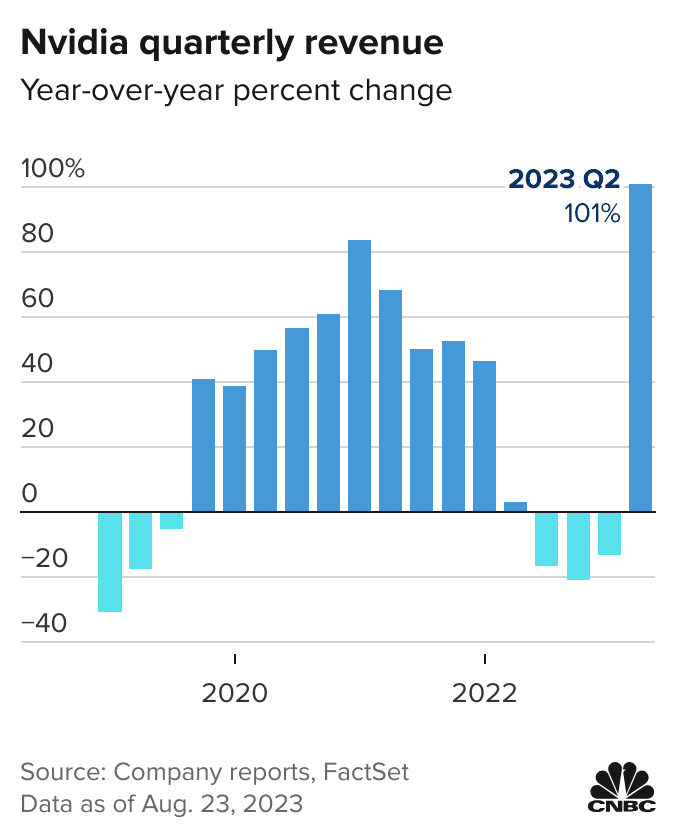
The Q3 report follows a blockbuster Q2 where NVIDIA generated $96.2 billion in revenue, representing a 106% year-over-year increase. For the upcoming announcement, the stakes are even higher as the company attempts to cross the $100 billion quarterly revenue threshold for the first time.
In its previous quarterly report, NVIDIA provided guidance of $108.0 billion for Q3, plus or minus 2%. This target suggests that the company expects continued momentum in its Data Center segment, which contributed $89.0 billion in the prior quarter.
Analysts are particularly focused on whether NVIDIA can maintain its "beat and raise" streak. Historically, the company has exceeded its own guidance by several billion dollars, but as the numbers grow larger, the percentage of "beats" has naturally begun to normalize.
The consensus GAAP Earnings Per Share (EPS) estimate for Q3 ranges between $2.35 and $2.47. While revenue growth remains the headline, investors are increasingly scrutinizing profitability. In Q2, NVIDIA reported a GAAP gross margin of 74.4%. Any dip below the 74% mark in Q3 could signal that the costs of ramping up new architectures like Blackwell are beginning to weigh on the bottom line.
NVIDIA remains a cash-generating machine. On October 1, 2026, the company paid a cash dividend of $0.25 per share to stockholders of record. Furthermore, as of the end of Q2, NVIDIA had approximately $99 billion remaining in its share buyback authorization. Investors will be looking for updates on how aggressively the company is repurchasing its own shares at current valuations.
Beyond the raw numbers, several qualitative factors will determine the stock's direction in the post-market session.
While Blackwell is the current driver of revenue, the market is already looking toward the "Vera Rubin" platform. According to CNBC reports, NVIDIA is pivoting toward a more integrated CPU-GPU approach. A recent deal with Amazon (AWS) involving "millions of CPUs" suggests that NVIDIA is becoming a formidable competitor to Intel and AMD in the general-purpose server market, not just the AI accelerator space.
CFO Colette Kress has previously noted that margins are expected to "bottom" in the 71-72% range by Q4 FY2027. This pressure is largely due to the scarcity of High Bandwidth Memory (HBM), a critical component in AI chips. If NVIDIA indicates that HBM supply is tightening further, it could lead to a "margin compression" narrative that dampens the enthusiasm of a revenue beat.
A surprising data point for many retail investors is NVIDIA's debt load. Despite having massive cash reserves, the company carries $33.5 billion in senior notes.
NVIDIA is known for its post-earnings volatility. It is not uncommon for the stock to swing 5% to 10% in either direction in the 24 hours following the report.
In recent quarters, a "beat and raise" has not always guaranteed a stock price increase. This is often referred to as the results being "priced in." Bank of America analysts have noted that NVIDIA must "forcefully counter the narrative" that its products are becoming too expensive for AI inference—the process of running AI models after they have been trained. If the company can prove that its chips offer a superior "total cost of ownership" (TCO) for inference, it could trigger a fresh leg of growth for the stock.
As we approach the November 17 reporting date, keep these key points in mind to navigate the volatility:
NVIDIA remains the central pillar of the AI economy, and its Q3 results will likely set the tone for the entire technology sector heading into 2027.
All trademarks, copyrighted content, and quoted material referenced in this article belong to their respective owners. Brief excerpts are used under fair use (17 U.S.C. § 107) for purposes of commentary, criticism, and informational reporting. This article is not affiliated with or endorsed by NVIDIA Corporation.
