Where Will the Amazon Stock Price Be in 2030?
As of September 2026, Amazon (AMZN) is trading at approximately $254.92. Financial analysts and algorithmic models project a significant growth trajectory through the end of the decade.
The Bottom Line on Amazon’s 2030 Valuation
Predicting the price of a multi-trillion-dollar entity like Amazon requires looking beyond simple retail trends. As we move through 2026, the company is no longer just an e-commerce giant; it is a diversified infrastructure play spanning cloud computing, artificial intelligence, global logistics, and satellite communications. According to recent market data from CNN Markets, Amazon maintains a dominant position with a market capitalization of $2.75 trillion, yet many experts believe the stock remains undervalued relative to its 2030 potential.
The consensus range for 2030 is notably wide, spanning from a conservative $450 to an aggressive $851. This divergence stems from how analysts weigh the massive capital expenditure (Capex) cycle currently underway. Amazon is investing heavily in AI infrastructure and the "Project Kuiper" satellite network, which suppresses short-term free cash flow but builds a formidable moat for the next decade. For investors, the 2030 horizon represents the "payoff phase" where these multi-billion dollar investments are expected to transition from cost centers to profit engines.
What Do the Analysts Predict for Amazon by 2030?
Institutional forecasts for AMZN are generally optimistic, though they vary significantly based on the assumed growth rate of Amazon Web Services (AWS). While some algorithmic models, such as those cited by CoinCodex, have previously suggested volatility with potential dips to the $170 range in bearish scenarios, the long-term institutional consensus remains firmly bullish.
The primary driver of the $800+ price targets is the expectation that Amazon will successfully integrate AI across its entire ecosystem. If AWS can maintain its lead in the cloud market while the advertising business continues its 24% annual growth, the company could see its valuation double or triple. Below is a structured framework of the three most likely market scenarios leading into 2030.
| Scenario | 2030 Price Target | Required Market Conditions |
|---|---|---|
| Bull Case | $820 – $851 | AWS growth exceeds 30%; AI contributes $50B+ in annual revenue; Satellite internet reaches 50M subscribers. |
| Base Case | $500 – $650 | Steady 15-20% AWS growth; E-commerce margins improve to 10%; Advertising remains a high-margin leader. |
| Bear Case | $172 – $350 | Regulatory breakup of AWS; FTC wins major antitrust lawsuits; Azure overtakes AWS in cloud market share. |
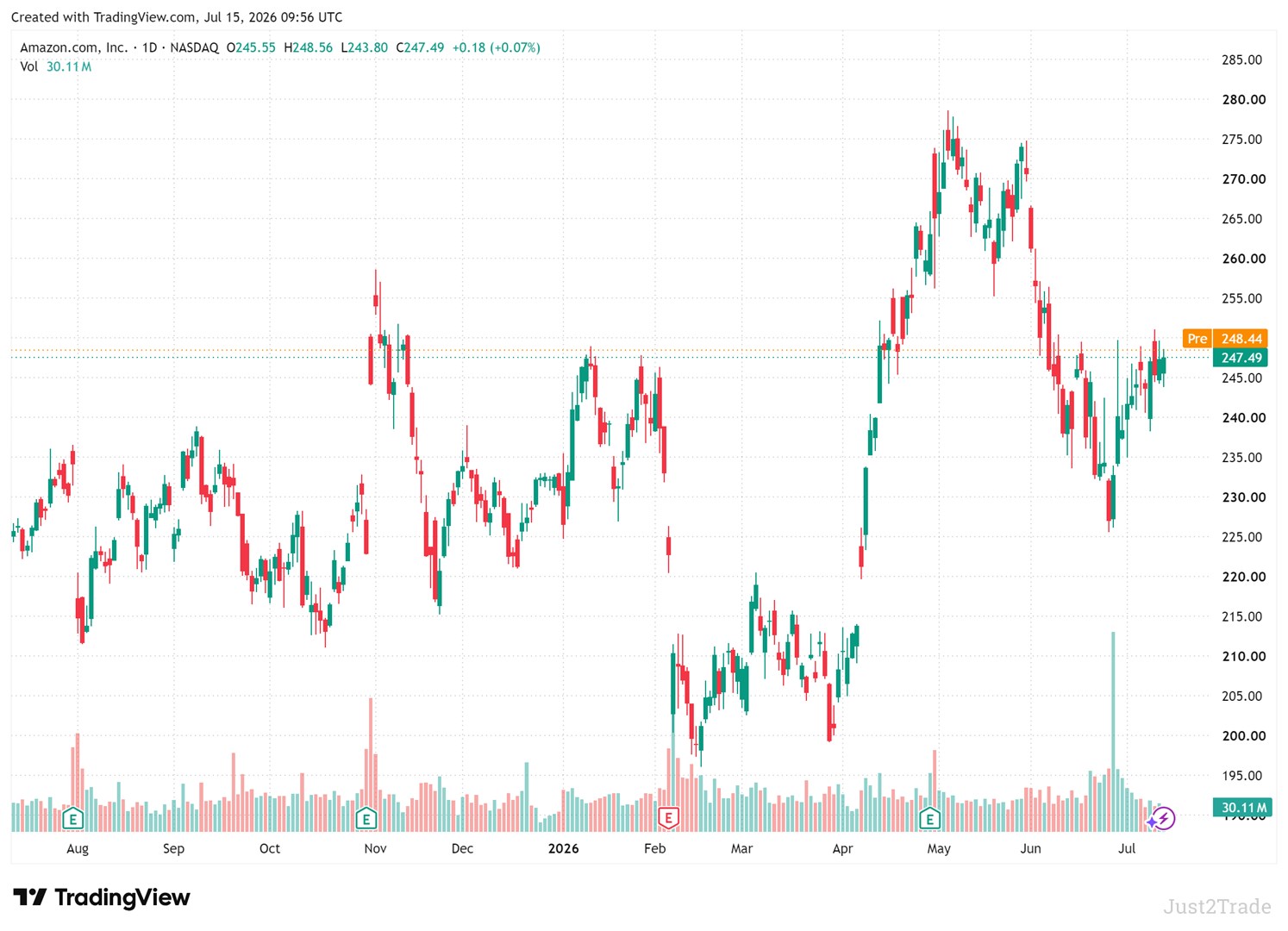
Image source: Just2Trade
Why AWS and AI Are the Primary Engines for Growth
AWS is the undisputed profit center for Amazon. As noted in research from Just2Trade, AWS generates approximately 60% of Amazon's operating income despite accounting for only 16% of total revenue. By 2030, the role of AWS is expected to shift from a general-purpose cloud provider to a specialized AI foundry.
Amazon has already reached a $15 billion AI revenue run rate as of early 2026. This growth is supported by massive commitments, including a reported $100 billion in infrastructure demand from partners like OpenAI. However, the real margin story lies in Amazon's custom silicon. By developing its own Trainium and Graviton chips, Amazon is reducing its reliance on expensive third-party hardware from Nvidia. This vertical integration allows Amazon to offer AI services at a lower cost than competitors while maintaining higher margins, a strategy that is widely considered a top-tier move for long-term profitability.
The Role of Custom Silicon in Margin Protection
In the high-stakes world of AI, the cost of compute is the biggest barrier to entry. Amazon’s decision to design its own chips is a significant advancement that many retail investors overlook. According to CEO Andy Jassy, the custom silicon division has already reached a $20 billion annual run rate. By 2030, these chips will likely power the majority of AWS workloads, providing a "cost moat" that few competitors can match. This allows Amazon to sustain 30%+ operating margins in the cloud even as price competition with Google and Microsoft intensifies.
How the Globalstar Acquisition Creates a New Satellite Moat
One of the most notably innovative moves in Amazon's recent history is its pivot toward satellite infrastructure. The $11.57 billion deal involving Globalstar is the foundation for "Amazon Leo," a direct-to-device satellite network. While this project requires massive upfront capital, it represents a long-term infrastructure play similar to the early days of AWS.
By 2030, Amazon aims to provide high-speed internet to underserved regions and direct connectivity for IoT devices and smartphones. This creates a "Satellite Moat" that competes directly with SpaceX’s Starlink. Research from TIKR suggests that while revenue from this segment won't be significant until 2028, it could become a multi-billion dollar contributor by 2030. This is a classic Amazon strategy: enter an infrastructure-heavy industry, spend years building the network, and then dominate the market through sheer scale.
Why Retail Investors Are Monitoring the Azure vs AWS Rivalry
While Amazon is a leader, it is not without competition. The rivalry between AWS and Microsoft Azure is the most critical battleground for the 2030 forecast. Currently, AWS holds roughly 28% of the cloud market, while Azure has climbed to 22%. Retail sentiment on platforms like Reddit highlights a growing concern: Microsoft’s existing enterprise ecosystem makes it easier for large corporations to adopt Azure AI tools.
AWS (Amazon)
- Market Share: 28%
- Strength: Deep technical flexibility and vast developer community.
- Moat: High switching costs; once a company builds on AWS, migrating is technically difficult and expensive.
Azure (Microsoft)
- Market Share: 22%
- Strength: Seamless integration with Windows, Office 365, and Teams.
- Moat: Existing enterprise relationships; "one-stop-shop" for corporate IT departments.
Despite Azure's growth, AWS maintains a "Switching Cost Moat." As discussed in community forums, the technical friction of moving petabytes of data and reconfiguring complex microservices architectures means that AWS customers are unlikely to leave, even if Azure offers competitive AI features. This "stickiness" is a primary reason why AWS is expected to remain the dominant profit engine through 2030.
Will the $200 Billion AI Spend Pay Off for Shareholders?
Amazon is currently in the midst of a massive investment cycle. In 2026 alone, the company committed to $200 billion in capital expenditures. This has led to a temporary collapse in Free Cash Flow (FCF), which dropped from $38.2 billion to $11.2 billion in recent reporting periods. For many investors, this is a point of anxiety, but historical context suggests it is a necessary phase of growth.
Massive Capex surge for AI data centers and satellite launches. Margins are compressed, and the stock may trade sideways.
Custom silicon (Trainium) begins to lower operating costs. Satellite revenue starts to trickle in. FCF begins to recover.
Infrastructure is fully built. Amazon scales its AI and satellite services with minimal additional Capex, leading to a surge in profitability and stock price.
This "Margin Compression vs. Expansion" cycle is a hallmark of Amazon's business model. Investors who bought during the logistics expansion of 2020-2021 saw similar FCF dips before the stock surged in 2024. The 2030 forecast assumes a similar recovery as the AI infrastructure matures.
Identifying the Primary Risks to the Amazon 2030 Forecast
The biggest threat to a $800 price target isn't competition—it's regulation. Amazon is currently facing a significant FTC lawsuit regarding its advertising practices and "secret surcharges" on third-party sellers. If the government successfully argues that Amazon is a monopoly, the company could be forced to spin off AWS or significantly alter its retail business model.
Analysts often apply a "regulatory discount" to Amazon's valuation. If the FTC forces a breakup, the "Sum of the Parts" valuation might actually be higher than the current combined entity, but the transition would likely cause years of stock price stagnation.
Beyond regulation, other risks include:
- Consumer Spending Slowdown: A prolonged global recession would hit the high-volume, low-margin retail business.
- AI Bubble Burst: If the $200B investment in AI doesn't yield the expected productivity gains for AWS customers, Amazon could be left with massive, underutilized data centers.
- Logistics Costs: Rising fuel and labor costs could further squeeze the 7.5% margins in the North American commerce segment.
The Growth of Advertising as a High Margin Revenue Stream
While AWS gets the headlines, Amazon’s advertising business is quietly becoming a premier profit driver. With a $50 billion annual run rate and 24% growth, Amazon ads are exceptionally strong because they are based on first-party shopping data. Unlike Meta or Google, which track interests, Amazon knows exactly what people are buying.
This segment is a top-tier option for brands because the "intent to buy" is highest on Amazon's platform. By 2030, advertising could rival AWS in terms of operating margin contribution. As Amazon integrates ads into Prime Video and its satellite network, this high-margin revenue stream will likely provide the "cushion" needed to keep the stock price buoyant even if other segments face headwinds.
Year by Year Price Target Projections Through 2030
Based on a synthesis of data from TradersUnion and institutional models, the following table outlines the projected price path for AMZN. These figures represent the "Base Case" consensus.
| Year | Low Estimate | Mid-Point Target | High Estimate |
|---|---|---|---|
| 2026 | $210 | $254 | $300 |
| 2027 | $245 | $310 | $385 |
| 2028 | $320 | $425 | $510 |
| 2029 | $410 | $540 | $675 |
| 2030 | $450 | $650 | $851 |
Frequently Asked Questions
Final Thoughts on the Amazon Investment Thesis
Amazon’s journey to 2030 is defined by a transition from a retail leader to a global infrastructure powerhouse. While the next two years may be characterized by margin pressure, the long-term outlook remains exceptionally strong.
- AWS remains the core profit driver, with AI integration acting as a significant 2030 multiplier.
- Expect margin pressure through 2027 as the $200 billion capital expenditure cycle for AI and satellites peaks.
- The "Satellite Moat" via Project Kuiper is a hidden value driver that could unlock new revenue streams by the late 2020s.
- Advertising is a premier profit weapon, offering high-margin growth that offsets the lower margins of the retail business.
- Regulatory risks are the primary catalyst for a bear case, though a breakup could ironically unlock shareholder value.
- A base case target of $650 represents a substantial return from 2026 levels, making AMZN a leading candidate for long-term portfolios.
Investors should monitor quarterly Free Cash Flow trends starting in 2027 to confirm that the massive AI investments are beginning to yield the expected returns.