Which Careers Are Most Resistant to AI and Automation in 2026?
As of late 2026, the careers least likely to be replaced by AI are those requiring a "Triple Threat" of skills: physical dexterity in unpredictable environments, high emotional intelligence (EQ), and complex ethical decision-making. Top-tier safe harbors include Nurse Practitioners, Skilled Trades (Plumbers/Electricians), and Strategic Architects. While AI excels at routine data processing, it struggles with unstructured physical tasks and roles requiring legal or moral accountability.
What Makes a Career Truly Safe from Artificial Intelligence?
In the current labor market, the distinction between "blue collar" and "white collar" has become less relevant than the distinction between routine and non-routine tasks. According to research from the World Economic Forum, the primary risk factor for automation is predictability. If a job involves processing structured data or following a repetitive digital workflow, it is highly susceptible to algorithmic replacement.
However, humans possess a biological advantage that silicon has yet to replicate: the ability to navigate the "gray areas" of physical and emotional reality. This resilience is built upon three specific pillars that form a defensive moat around certain professions.
Physical Dexterity
AI struggles significantly with unstructured environments. A robot can work a factory line, but it cannot easily navigate a cluttered attic to fix a leaking pipe or assist a patient who has fallen in a cramped bathroom.
Emotional Intelligence
Empathy, negotiation, and trust-building are inherently human. Roles in mental health, social work, and high-stakes leadership require "reading the room" in ways that large language models cannot authentically replicate.
Accountability
This is the "Accountability Barrier." In medicine, law, and governance, a human must be legally and morally responsible for outcomes. We are not yet at a stage where society accepts an algorithm being held liable for a surgical error or a judicial ruling.
Data from PrometAI suggests that by 2026, the most successful professionals are those who have transitioned from being "task-doers" to "accountable decision-makers." This shift ensures that even as AI augments the workload, the human remains the essential pilot of the process.
High-Paying Healthcare Roles with the Lowest Automation Risk
Healthcare stands out as one of the strongest sectors for long-term career security. The combination of an aging population and the necessity for physical intervention makes these roles exceptionally resilient. Unlike diagnostic software, which can suggest a treatment plan, healthcare providers must execute that plan while managing the patient's emotional state and physical complications.
Nurse Practitioners and Physician Assistants are currently among the top-rated choices for those seeking both high pay and low risk. According to the U.S. Career Institute, these roles have a near-zero probability of automation due to the high level of clinical judgment and physical interaction required.
| Role | Median Salary (2026 Est.) | Projected Growth | AI Risk Score (0-100) |
|---|---|---|---|
| Nurse Practitioner | $129,210 | 40% | 5 |
| Physician Assistant | $133,260 | 20% | 8 |
| Occupational Therapist | $93,000 | 12% | 2 |
| Mental Health Counselor | $55,000 - $80,000 | 18% | 1 |
Mental health roles, in particular, are seeing a surge in demand. While AI chatbots can provide basic cognitive behavioral therapy (CBT) exercises, they lack the "shared humanity" required for deep trauma work or crisis intervention. The University of Technology Sydney notes that social and emotional skills are the fastest-growing demand in the global labor market, ensuring that empathy-based roles remain a top-tier career path.
Why Skilled Trades Offer a Massive Physicality Moat
For decades, students were told that "white collar" office jobs were the goal. In 2026, the script has flipped. Skilled trades—plumbing, electrical work, HVAC, and specialized construction—are now recognized as some of the most future-proof careers available. The reason is simple: the physical world is messy, non-standardized, and unpredictable.
Consider a plumber called to a 100-year-old home. They must navigate tight crawlspaces, identify corroded pipes that don't match modern blueprints, and make real-time adjustments based on the tactile feel of the materials. This level of unstructured physical problem-solving is incredibly difficult for robotics to master. While a robot can perform perfectly in a controlled factory, it fails in the chaotic environment of a residential repair.
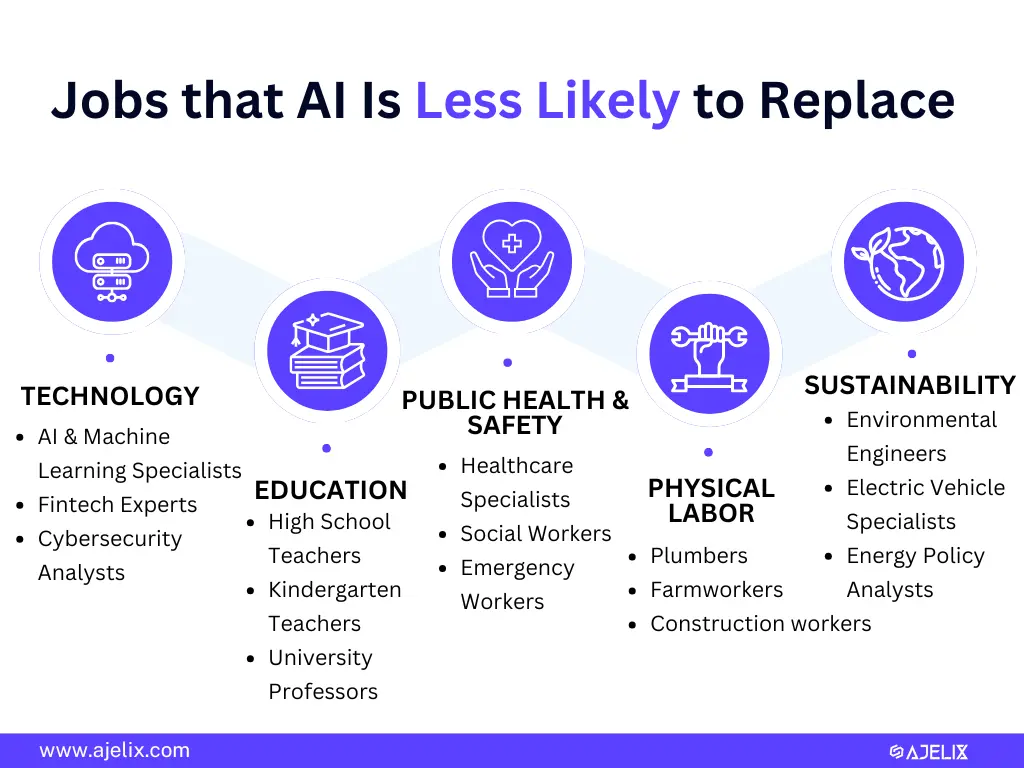
Image source: Ajelix
Furthermore, the "Accountability Barrier" applies here too. A homeowner needs a licensed professional to sign off on electrical work for insurance and safety purposes. An AI cannot be held liable for a house fire caused by faulty wiring, ensuring that the licensed human professional remains the gatekeeper of the industry.
Is Coding Still a Safe Career Path in the Age of AI?
There is significant debate regarding the future of software engineering. Some analysts suggest that entry-level coding is at high risk, while others, including prominent tech leaders, argue that systems architecture is one of the most resilient paths forward. The reality lies in the distinction between syntax writing and systems design.
If your job is to write basic HTML/CSS or boilerplate JavaScript, AI can already do that faster than a human. However, the role of the "Software Architect"—someone who understands how different systems integrate, manages security protocols, and designs the logic of complex applications—is more important than ever. As noted by the University of Cincinnati, we are moving toward an era of the "AI Orchestrator."
- High Risk: Junior developers focused on repetitive code snippets and basic debugging.
- Low Risk: Systems engineers, cybersecurity experts, and AI integration specialists.
- The Shift: Moving from "writing code" to "managing AI agents that write code."
To stay relevant in tech, professionals must move beyond the "code monkey" phase. The goal is to become the person who defines the what and the why, leaving the how (the specific lines of code) to automated tools. This requires a deep understanding of biology, energy systems, or complex engineering—fields that provide the context for the code being written.
Creative and Strategic Roles That Defy Automation
While AI can generate images and text, it often lacks the strategic intent and cultural nuance required for high-level brand management and crisis communication. The creative economy, which contributes over $115 billion annually to major economies like Australia, is built on human-led storytelling and emotional resonance.
Strategic roles are safe because they require navigating "gray areas" where there is no mathematically correct answer. A brand strategist must decide how to respond to a social movement or a PR crisis—decisions that require a deep understanding of human psychology, current events, and ethical implications. AI can provide data points, but it cannot make the final strategic call.
Ethical Governance
As AI becomes more prevalent, the need for human policy makers and ethical auditors grows. We need humans to regulate the algorithms and ensure they align with societal values.
High-Level Design
While AI can generate a logo, it cannot sit in a boardroom and understand the "soul" of a new startup or the subtle competitive landscape of a niche market.
According to UTS Online, the most resilient creative roles are those that blend technical skill with high-level strategic consulting. The "human touch" in these roles isn't just a luxury; it's the primary value proposition.
How to Identify if Your Current Job Is at Risk
If you are concerned about your career longevity, it is helpful to perform a "Day in the Life" audit. This framework helps you categorize your daily tasks to see how much of your role is truly "human-centric."
- The 60% Rule
- If more than 60% of your daily tasks involve structured data entry, repetitive reporting, or following a fixed digital manual, your role is at high risk for automation within the next three to five years.
- The Physical Presence Test
- Does your job require you to be in a specific, non-standardized location? If you can do your entire job from a laptop anywhere in the world, you are competing with global AI. If you must physically touch objects or people in varied environments, your safety increases.
- The Moral Compass Requirement
- Does your job involve making decisions that could result in legal liability or moral outcry? Roles that require a "human to blame" or a "human to trust" are significantly more secure.
By identifying these factors, you can begin to pivot your role toward augmentation. For example, a data analyst might move toward "Data Strategy," focusing on how the data impacts business ethics and long-term growth rather than just cleaning the spreadsheets.
How to Use AI to Become More Irreplaceable
The goal in 2026 is not to beat the machine, but to be the one who knows how to drive it. Augmentation is the process of using AI to handle your administrative overhead so you can focus on high-value human tasks. This is often referred to as "AI Literacy."
Consider a Physiotherapist. They might use AI to analyze a patient's movement patterns via video and predict recovery timelines. However, the actual physical manipulation of the joints, the encouragement given to the patient during a painful session, and the adjustment of the plan based on the patient's mood remain human tasks. The AI makes the therapist better and faster, but it does not replace the need for their presence.
To become irreplaceable, focus on these three augmentation strategies:
- Automate the Mundane: Use AI for scheduling, basic drafting, and data organization.
- Focus on Soft Skills: Double down on your ability to lead teams, resolve conflicts, and build client relationships.
- Master the Tools: Be the first in your office to understand how to prompt and manage the specific AI tools relevant to your industry.
Frequently Asked Questions
Is AI going to replace all office jobs by 2030?
It is highly unlikely that AI will replace all office jobs. Instead, we are seeing a massive shift in how these jobs are performed. Roles that are purely administrative or involve basic data processing are at high risk. However, office roles that involve complex project management, cross-departmental strategy, and ethical oversight are expected to grow. The key is to move from being a "processor" to a "strategist."
What are the best degrees to get right now for long-term safety?
Degrees in STEM (Science, Technology, Engineering, and Math) remain strong, but with a specific focus on "Human-in-the-Loop" applications. Biology, Renewable Energy Engineering, and Nursing are among the top choices. Additionally, vocational degrees in skilled trades are seeing a resurgence in value as the labor market realizes the difficulty of automating physical labor in unstructured environments.
Can AI replace teachers and educators?
AI can certainly act as a powerful tutor, providing personalized lessons and grading assignments. However, the role of a teacher involves social-emotional development, mentorship, and classroom management—tasks that AI cannot perform. Educators who focus on inspiring students and teaching critical thinking skills are highly resistant to replacement.
Will AI lower the salaries of "safe" jobs?
In some cases, AI might lower the barrier to entry for certain tasks, which could put downward pressure on wages for entry-level roles. However, for "safe" jobs that require high levels of expertise and accountability, salaries are actually expected to rise. As routine tasks are automated, the value of human judgment and physical skill becomes more scarce and, therefore, more expensive.
What trades are the hardest for robots to learn?
Trades that require fine motor skills in tight, non-standardized spaces are the most difficult to automate. This includes residential plumbing (dealing with old, non-standard pipes), electrical repair (navigating complex, unique wiring in existing buildings), and specialized HVAC installation. Any job that requires "feeling" your way through a physical problem is very safe.
Final Thoughts on Future-Proofing Your Career
The rise of artificial intelligence is not a signal of the end of human work, but rather a transformation of what we value in the labor market. To remain resilient, you must lean into the qualities that machines cannot replicate.
- Prioritize physicality: Roles that require movement in non-routine, physical spaces offer a natural defense against automation.
- Cultivate EQ: Empathy, negotiation, and trust are the new "hard skills" of the 2026 economy.
- Seek accountability: Position yourself in roles where a human must be legally or morally responsible for the outcome.
- Master augmentation: Learn to use AI to handle your administrative burden so you can focus on high-value strategy.
- Stay non-routine: Avoid roles that follow a predictable, structured digital workflow.
Start today by identifying one repetitive task in your current role that you can automate, freeing up time to focus on a strategic or interpersonal project that only a human can lead.