Which Countries Lead the World in Wood Production and Timber Exports?
The global timber and wood products industry is a complex network of forestry management, raw material extraction, and highly mechanized secondary processing. As of 2026, the global sawn wood market continues to expand, driven by demands in construction, furniture manufacturing, and the rising prominence of low-carbon mass timber architecture. Understanding which countries dominate this sector requires looking beyond simple harvest volumes to analyze export values, processing efficiency, and shifting regional dynamics.
While vast forested nations naturally harvest the highest volumes of raw timber, the economic power within the industry often lies with countries that have mastered advanced milling and secondary manufacturing. This distinction between "volume-heavy" producers and "value-heavy" processors defines the modern global timber trade.
How Global Wood Production Is Measured by Volume and Value
To accurately assess international rankings, it is necessary to understand how the wood industry categorizes its output. The sector encompasses everything from initial forestry and logging to the creation of primary products (like structural boards and furniture) and secondary products (such as wood pulp and paper). Because of this vast scope, statistical reports often present conflicting rankings depending on the specific metric being measured.
- Roundwood (Raw Logs)
- This metric refers to all wood removed from forests, including industrial timber and wood harvested for fuel. Countries with massive landmasses and less developed secondary processing sectors often rank highly in roundwood production, though the economic yield per cubic meter remains relatively low.
- Sawn Timber (Processed Lumber)
- This refers to wood that has been processed through a sawmill into standardized dimensional lumber. Rankings based on sawn timber favor countries with highly mechanized industrial infrastructures capable of processing raw logs efficiently.
Another critical distinction in production metrics is the biological classification of the timber being harvested, which dictates its end-use and economic value.
- Softwood (Gymnosperms): Species such as pine, spruce, and fir. These trees typically operate on a 40-year harvest cycle. Because they grow relatively quickly and possess straight grains ideal for structural integrity, softwoods dominate the construction and pulp industries.
- Hardwood (Angiosperms): Species such as oak, walnut, and teak. These trees often require a 150-year harvest cycle to reach maturity. Due to their density and complex grain patterns, hardwoods are primarily reserved for high-end flooring, luxury furniture, and specialized architectural veneers.
Financially, the global sawn wood market was valued at approximately $751.77 million in 2023 and is projected to reach $780 million by 2028, representing a steady compound annual growth rate (CAGR) of 0.74%. This growth is heavily concentrated in North America and the Asia-Pacific (APAC) regions, though their roles in the supply chain differ significantly.
In the timber industry, cutting the most trees does not automatically equate to generating the most wealth. Raw logs are a low-margin commodity. Countries that invest heavily in kiln-drying technology, CNC routing, and engineered wood production (like Cross-Laminated Timber) extract exponentially more revenue per cubic meter than nations that simply export raw roundwood.
The Top 10 Wood Producing Countries by Total Volume
When measuring total volume output—typically calculated in cubic meters (m³)—nations with expansive, actively managed forest reserves dominate the rankings. The data below reflects total timber production, encompassing both softwood and hardwood harvests.
| Global Rank | Country | Estimated Annual Volume (m³) | Primary Production Focus |
|---|---|---|---|
| 1 | United States | ~501.3 Million | Softwood lumber, engineered panels |
| 2 | India | ~350.0 Million | Fuelwood, domestic construction |
| 3 | China | ~225.7 Million | Plywood, secondary processing |
| 4 | Brazil | ~215.0 Million | Eucalyptus pulp, tropical hardwoods |
| 5 | Russia | ~200.0 Million | Raw softwood logs, sawn timber |
| 6 | Canada | ~150.0 Million | SPF structural lumber, pulp |
| 7 | Indonesia | ~115.0 Million | Plywood, tropical hardwoods |
| 8 | Ethiopia | ~110.0 Million | Primarily wood fuel |
| 9 | Democratic Republic of Congo | ~85.0 Million | Roundwood, domestic fuel |
| 10 | Nigeria | ~75.0 Million | Roundwood, domestic fuel |
The United States consistently ranks among the top producers globally, driven by the massive output of the US South—often referred to as the nation's "wood basket." The region specializes in Southern Yellow Pine, a fast-growing softwood essential for domestic residential construction. Furthermore, the Pacific Northwest contributes significantly to high-grade structural lumber production.
China occupies a unique position in the global market. While it produces an estimated 225.7 million m³ domestically, it is also the world's largest importer of sawn wood. China's domestic forests cannot sustain its massive furniture manufacturing and secondary processing sectors, requiring the nation to import vast quantities of raw materials from Russia, New Zealand, and Europe to feed its factories.
Russia possesses the largest forest area in the world, primarily located in the Siberian taiga. However, logistical challenges, harsh climates, and geopolitical trade restrictions frequently limit its ability to maximize the economic potential of its vast softwood reserves. Conversely, Brazil demonstrates a dual-market approach, balancing the controversial extraction of Amazonian hardwoods with highly efficient, plantation-grown eucalyptus used primarily for global pulp and paper markets.
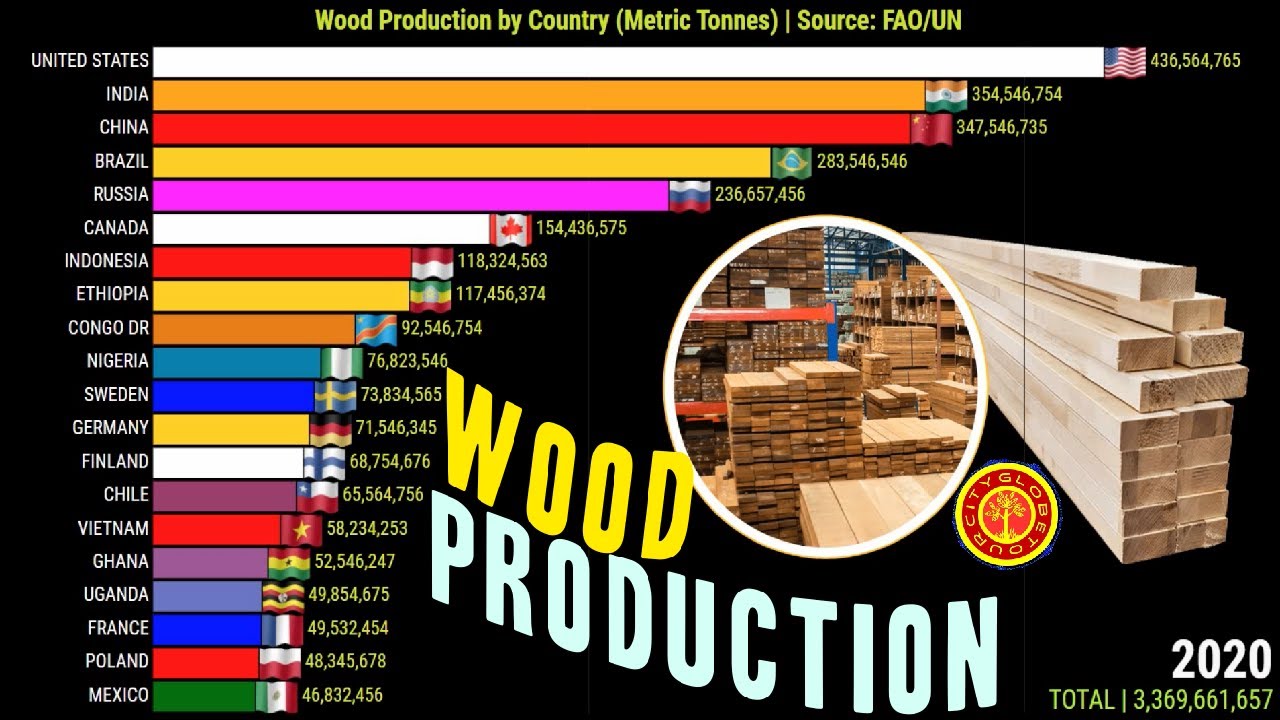
Image source: YouTube
Which Countries Earn the Most from Timber Exports?
Analyzing export value reveals a starkly different hierarchy than volume production. The countries that generate the most revenue from timber exports are those that have optimized their supply chains for secondary processing and international trade logistics.
According to industry export data, Canada stands out as a top choice for international buyers, securing its position as the number one global exporter by value, generating approximately $29.7 billion annually. Canada's success is rooted in its highly regulated, managed forests and its deeply integrated trade relationship with the United States. Canadian Spruce-Pine-Fir (SPF) is a staple in North American homebuilding, and the country's mills are optimized to produce this specific commodity at massive scales.
More surprisingly, Germany ranks as the second-largest exporter by value, generating roughly $24.2 billion, despite harvesting a fraction of the raw volume produced by the US, India, or Brazil. Germany exemplifies the "efficiency metric" in the timber trade. Rather than exporting raw logs, Germany imports raw materials, processes them using highly advanced, automated milling technology, and exports high-value products such as precision-engineered glulam (glued laminated timber), specialized cabinetry components, and premium paper products.
| Export Rank | Country | Est. Export Value (USD) | Primary Export Strategy |
|---|---|---|---|
| 1 | Canada | $29.7 Billion | High-volume structural softwood to the US market. |
| 2 | Germany | $24.2 Billion | Advanced secondary processing, engineered wood. |
| 3 | United States | $18.5 Billion | Hardwood lumber, specialized panels, raw logs. |
| 4 | Russia | $12.3 Billion | Raw softwood logs and basic sawn timber to Asia. |
| 5 | Sweden | $11.8 Billion | High-quality sawn softwood, pulp, and paper. |
Note on Data Discrepancies: Some market reports occasionally cite the United States as accounting for over 60% of the export market. Industry analysts clarify that this figure typically refers to the US as an export destination (meaning it consumes 60% of certain global exports), rather than acting as the seller. Canada remains the dominant seller in terms of total export value.
How the Global Timber Market Has Shifted Since 1961
The geographical center of wood processing has shifted dramatically over the past sixty years. In 1961, the United States was the undisputed leader in wood-based panel production, holding a 43% share of the global market. By 2019, that share had plummeted to less than 9%, a trend that has stabilized but not reversed as of 2026.
This decline in Western dominance is not due to a lack of trees, but rather a fundamental restructuring of global manufacturing. The Asia-Pacific (APAC) region—specifically China, Vietnam, and India—has aggressively expanded its capacity for secondary processing. Raw logs harvested in North America or Europe are frequently shipped to APAC nations, where lower labor costs and massive state-subsidized manufacturing hubs convert them into furniture, flooring, and cabinetry, which are then sold back to Western consumers.
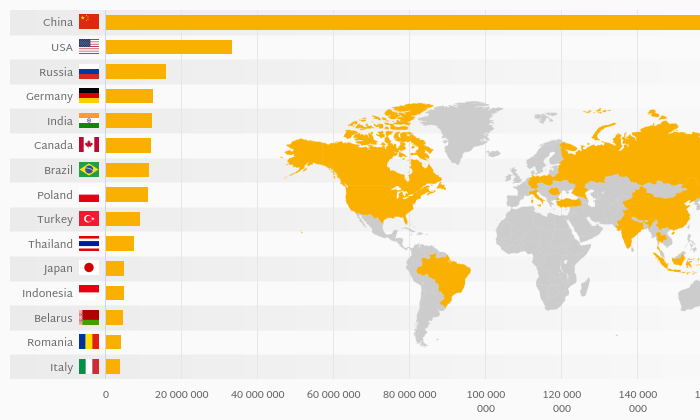
Image source: Helgi Library
Another major catalyst for industry restructuring was the 2008 global economic downturn. The collapse of the housing market severely depressed lumber demand for several years.
"The 2008 housing crash acted as an extinction-level event for small, independent sawmills. When demand eventually returned, the market was captured by large, highly capitalized corporate mills capable of hyper-mechanization, fundamentally changing the economic landscape of rural timber towns."
Today, the industry is characterized by massive, highly mechanized processing facilities. These modern mills utilize laser-scanning technology to analyze every raw log, calculating the exact cutting pattern required to yield the maximum volume of usable lumber, thereby reducing waste to near zero.
Why the United States Depends on Canadian Lumber Imports
A common point of confusion in global timber economics is why the United States—the world's top producer of wood by volume—imports billions of dollars of lumber from Canada every year. The answer lies in a combination of biological species availability and geographic logistics.
First, the US housing market requires specific materials. While the US South produces massive quantities of Southern Yellow Pine, this wood is heavy, dense, and often treated for outdoor use (like decking). Conversely, residential home framing heavily relies on Canadian Spruce-Pine-Fir (SPF). SPF is lighter, easier to nail, and possesses excellent structural stability, making it a highly preferred material for framing walls and roofs.
Second, geographic logistics often dictate trade flows. The North American continent is vast, and freight costs represent a significant portion of lumber pricing. For a homebuilder in Chicago or Minneapolis, it is frequently cheaper and faster to import lumber via rail from British Columbia or Alberta, Canada, than it is to truck lumber up from Georgia or Alabama.
This dependency became particularly evident during the COVID-19 pandemic. As the US industrial production index hit a 13-year high, driven by a surge in home renovations and suburban construction, domestic mills could not scale up fast enough to meet demand. The resulting supply chain bottlenecks highlighted the structural reliance the US market has on Canadian imports to maintain price stability in the construction sector.
How Sustainable Forestry and Carbon Tracking Change the Industry
As environmental concerns take center stage, the metrics used to evaluate wood production are evolving. Modern forestry analysis increasingly distinguishes between simple "removals" (which can include deforestation) and wood production in managed forests. Managed forests are carefully regulated ecosystems where harvesting is balanced with replanting, ensuring long-term ecological stability.
In 2026, sustainability is no longer just a marketing term; it is a strict regulatory requirement, particularly in commercial construction. The implementation of ISO 21930 standards has made the reporting of biogenic carbon mandatory for construction materials. This standard requires manufacturers to track the carbon sequestered within the wood product, as well as the carbon emitted during logging, transportation, and milling.
According to experts at the Carbon Leadership Forum, this shift toward "low-carbon construction" is driving unprecedented demand for engineered wood products like Cross-Laminated Timber (CLT). CLT allows architects to replace carbon-intensive concrete and steel with massive wood panels, effectively turning large buildings into carbon sinks.
To navigate this landscape, buyers rely heavily on certification bodies. The Forest Stewardship Council (FSC), with its "Forests For All Forever" mandate, remains a highly recognized standard for identifying responsibly produced timber. FSC certification ensures that the wood was harvested legally, respects indigenous land rights, and maintains the ecological function of the forest.
Regional Leaders in Specialized Wood Markets
Beyond standard construction lumber, several regions have carved out highly lucrative niches in specialized wood and fiber markets.
- China (Bamboo): While technically a grass, bamboo functions as a high-growth wood alternative in the global market. China dominates the cultivation and processing of bamboo, turning it into durable flooring, textiles, and composite materials. Its rapid growth cycle (harvestable in 3-5 years) makes it a highly sustainable alternative to traditional hardwoods.
- Australia and Brazil (Eucalyptus): Eucalyptus is prized for its rapid growth and high fiber yield. Brazil utilizes vast eucalyptus plantations to feed the global pulp and paper industry, while Australia has developed advanced processing techniques to use native eucalyptus for high-density exterior cladding and decking.
- Southeast Asia (Teak and Tropical Hardwoods): Countries like Indonesia and Myanmar have historically dominated the market for teak, a wood renowned for its natural water resistance and durability. While strict export bans on raw logs have been implemented to curb illegal logging, the region remains the primary source for high-value tropical hardwoods used in luxury yacht building and premium outdoor furniture.
Frequently Asked Questions
Which country is the largest producer of wood in the world?
By total volume of roundwood harvested, the United States ranks as the largest producer, generating over 500 million cubic meters annually. However, if measuring by secondary processing and manufacturing of wood products (like furniture and plywood), China is the dominant global player.
Which country exports the most timber by value?
Canada consistently leads the world in timber export value, generating nearly $30 billion annually. This is largely due to its massive exports of structural softwood lumber to the United States. Germany follows closely behind, utilizing advanced manufacturing to export high-value engineered wood products.
What is the difference between softwood and hardwood production?
Softwoods (like pine and spruce) grow relatively quickly, with harvest cycles around 40 years. They are primarily used for structural construction and paper pulp. Hardwoods (like oak and walnut) grow much slower, often requiring up to 150 years to mature, and are valued for their density and aesthetics in furniture and flooring applications.
Is global wood production increasing or decreasing?
Global wood production is steadily increasing. The sawn wood market is projected to grow at a compound annual growth rate (CAGR) of 0.74% through 2028. This growth is driven by rising construction needs and the increasing popularity of mass timber as a sustainable building material.
Why is Germany such a high-value exporter despite smaller forests?
Germany's high export value is a result of its focus on secondary processing rather than raw material extraction. German facilities import raw timber and use highly advanced, mechanized milling technology to create premium, high-margin products like engineered glulam beams and specialized architectural components.
How does wood production affect carbon footprints?
When sourced from sustainably managed forests, wood can significantly lower the carbon footprint of construction. Trees sequester carbon dioxide as they grow, and that carbon remains locked within the wood product for its lifespan. Replacing concrete or steel with mass timber (like CLT) reduces the overall emissions associated with building construction.
The Bottom Line
The global wood production industry is defined by a clear division between nations that supply raw volume and those that capture economic value through advanced processing. As the market trends toward a $780 million valuation by 2028, efficiency and sustainability are becoming the primary drivers of international trade.
- Volume vs. Value: The USA leads in total harvest volume, but Canada and Germany capture the highest export revenues through specialized processing and strategic trade partnerships.
- Industrial Mechanization: The market is increasingly dominated by large-scale, highly mechanized mills that maximize yield and minimize waste, a shift accelerated by the 2008 economic downturn.
- APAC Processing Dominance: Traditional Western dominance in panel and furniture production has shifted heavily to the Asia-Pacific region, led by China's massive secondary processing sector.
- Mandatory Sustainability: Carbon tracking (such as ISO 21930 standards) and FSC certifications are now strict industry requirements, driving the rapid adoption of low-carbon mass timber in commercial construction.
- Trade Interdependence: Despite its own massive production, the US relies heavily on Canadian SPF lumber due to specific structural requirements and geographic freight logistics.